

Marketing teams tend to have plenty of analytics and very little intelligence, and most use the two words as if they're interchangeable. They aren't.
Your GA4 dashboard tells you how your campaigns performed: sessions, conversions, CAC by channel. That's analytics, and it does its job well. What it won't tell you is what your two biggest competitors just launched, whether the category grew or shrank last quarter, or why a rival's paid search spend suddenly tripled. That's intelligence, and it lives outside your own numbers.
The distinction is easy to blur, and it isn't just semantic. Teams that treat analytics and intelligence as one discipline end up with dashboards that are excellent at describing their own past and useless at explaining the market around them. This guide draws a clean line between the two, shows where they overlap, and gives you a practical framework for building both into a genuinely data-driven marketing practice, without duplicating your reporting stack.
In short
- Marketing analytics measures your own performance. It answers "how did our campaigns, channels, and content perform" using data you own, GA4, CRM, ad platforms.
- Marketing intelligence measures the market around you. It answers "what is happening in our category" using data you do not own, competitor moves, market trends, share of voice, industry benchmarks.
- The confusion is costly. Teams that only build analytics can report performance clearly but cannot explain why performance shifted or what to do next.
- They are sequential, not competing. Intelligence explains the "why" behind what analytics shows you. Neither replaces the other.
- The Hurree view: Most marketing teams have a mature analytics layer and almost no intelligence layer. That imbalance is the single biggest blind spot in modern marketing reporting.

The core distinction
At the simplest level, marketing analytics is internal and quantitative. Marketing intelligence is external and contextual. One measures what you did. The other measures what is happening around you while you did it.
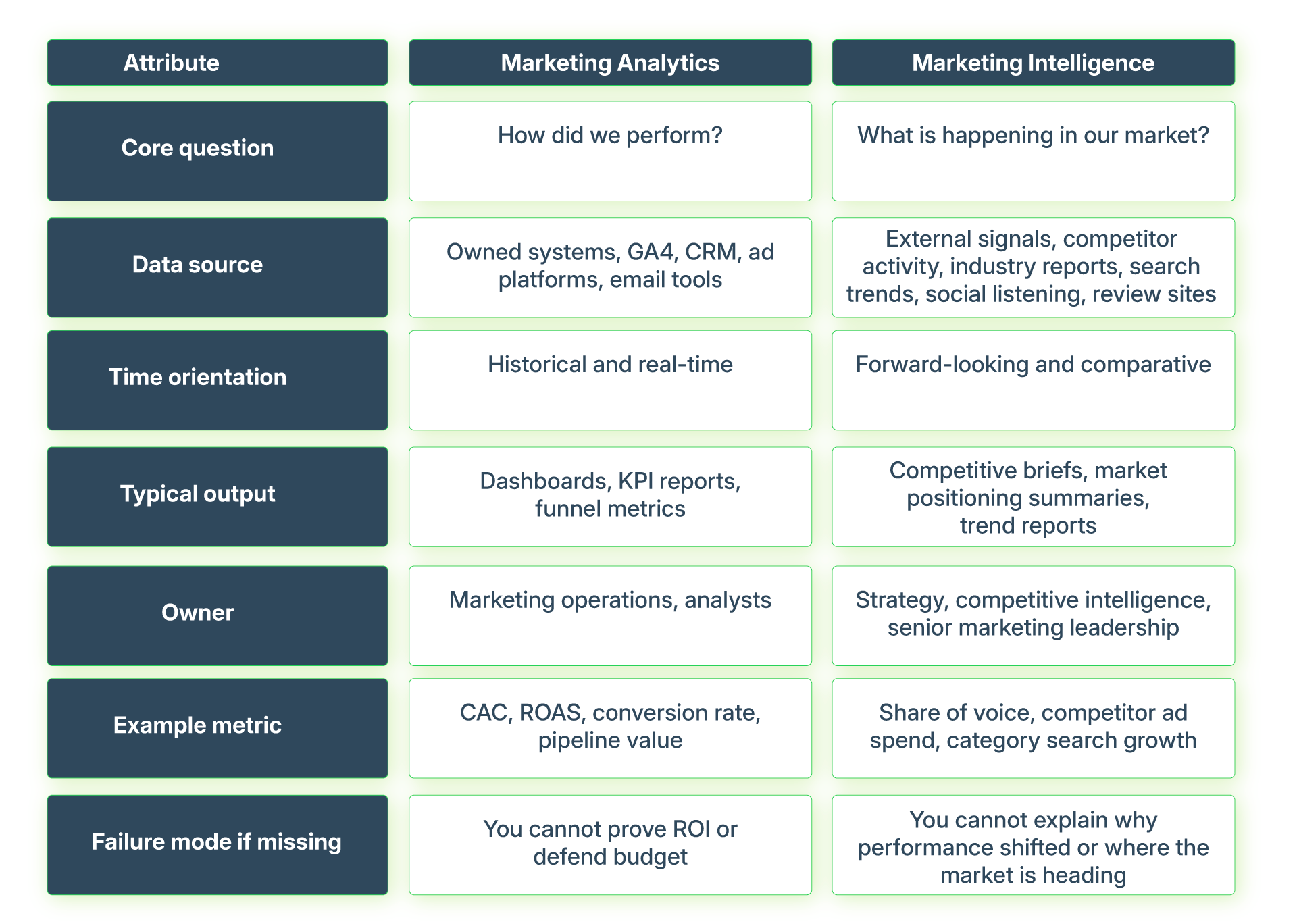
Both disciplines use the word "data." That is where most of the confusion starts. Analytics data describes your actions. Intelligence data describes the environment those actions happened in.
This distinction also sits inside a broader hierarchy. General business intelligence looks at the overall operational and financial health of a company. Marketing analytics narrows that lens specifically to the customer journey and channel performance. Marketing intelligence sits alongside both, adding the external market context that neither internal discipline captures on its own.
Why marketing teams should care
Marketing teams live and die by their ability to answer two very different questions in the same meeting: "How are we doing?" and "Why are we doing that, and what should we do next?"
Analytics answers the first question well. It struggles with the second. If your Q3 conversion rate dropped 12%, your GA4 dashboard will confirm the drop with confidence and precision. It will not tell you that a competitor launched a free-tier product the same week, or that a category-wide algorithm update quietly changed how your entire vertical ranks in search.
Without an intelligence layer, marketing teams end up solving external problems with internal tools. They optimize ad copy when the real issue is a competitor's pricing change. They rebuild a landing page when the real issue is a shift in category-wide search intent. The fix looks reasonable on paper and does nothing to the metric, because the root cause was never inside the dashboard to begin with.
This is also a budget conversation. Defending spend against a core KPI like CAC requires more than the number itself. When leadership asks "why did CAC rise," "we don't know, but our dashboard confirms it happened" is a weak answer. "CAC rose because our two closest competitors both increased ad spend 40% this quarter, and our data confirms it hit their same three keyword clusters" is a strategic answer, and it is only possible when analytics and intelligence are read together.

Source: Leftronic
Real-world examples: Same data, different questions
The clearest way to see the difference is to watch both disciplines respond to the same business moment.
Scenario 1: A competitor launch
- Analytics tells you: Organic traffic to your pricing page dropped 18% over two weeks. Conversion rate on that page held steady.
- Intelligence tells you: A competitor launched a comparison landing page targeting your brand name, and is now ranking above you for "[your product] alternative."
- Combined insight: The traffic loss is not a content quality problem. It is a competitive positioning problem, and the fix is a comparison page of your own, not a rewrite of the existing one.
Scenario 2: A budget reallocation decision
- Analytics tells you: Paid social CAC increased from $180 to $240 over the quarter.
- Intelligence tells you: Industry benchmark reports show category-wide CPMs rose 30% due to a seasonal spike in advertiser demand across your vertical.
- Combined insight: The CAC increase is a market-wide cost shift, not a campaign performance failure. The response is patience and creative refresh, not a full channel exit.
Scenario 3: A stalled category
- Analytics tells you: Your MQL volume has been flat for three months despite steady spend.
- Intelligence tells you: Category-wide search volume for your core keyword cluster has declined 15% year-over-year, and share of voice data shows a new entrant capturing the demand that remains.
- Combined insight: This is not a lead generation execution problem. It is a market contraction combined with new competitive pressure, which changes the strategic response entirely, from "optimize the funnel" to "diversify demand sources."
In every case, analytics correctly identifies that something changed. Intelligence explains why. Without both, teams either misdiagnose the problem or spend weeks investigating a cause that was visible in a competitor's press release the whole time.
The Hurree framework: The signal stack
Most teams build their analytics layer first, because the data is easier to access; it already lives in tools they own. Intelligence gets treated as a "nice to have" research project instead of a standing discipline. To build both without duplicating effort, we use a four-layer signal stack:
- Internal performance signals. Your owned data, GA4, CRM, ad platform reporting. This is your marketing analytics foundation and should already be centralized in a single dashboard.
- External market signals. Competitor pricing pages, ad libraries and competitor analysis tools (Meta Ads Library, Google Ads Transparency Center), industry benchmark reports, and search trend data (Google Trends, category-level keyword volume).
- Synthesis. Where performance shifts get matched against market signals. This is the step most teams skip entirely, the two data sets are read separately instead of side by side.
- Action. A specific, attributed recommendation that names both the internal metric that moved and the external cause behind it.
Skipping layer three is the single most common gap. Teams often have excellent dashboards and a folder of competitor screenshots, but nobody is responsible for connecting the two. That connection is where marketing intelligence actually lives.
Template: A monthly intelligence brief you can copy
If you are demonstrating what a functioning intelligence layer looks like, to your own team or in a client or leadership pitch, this is a lightweight structure that pairs cleanly with an existing analytics dashboard, sitting alongside the core metrics you already report on monthly.
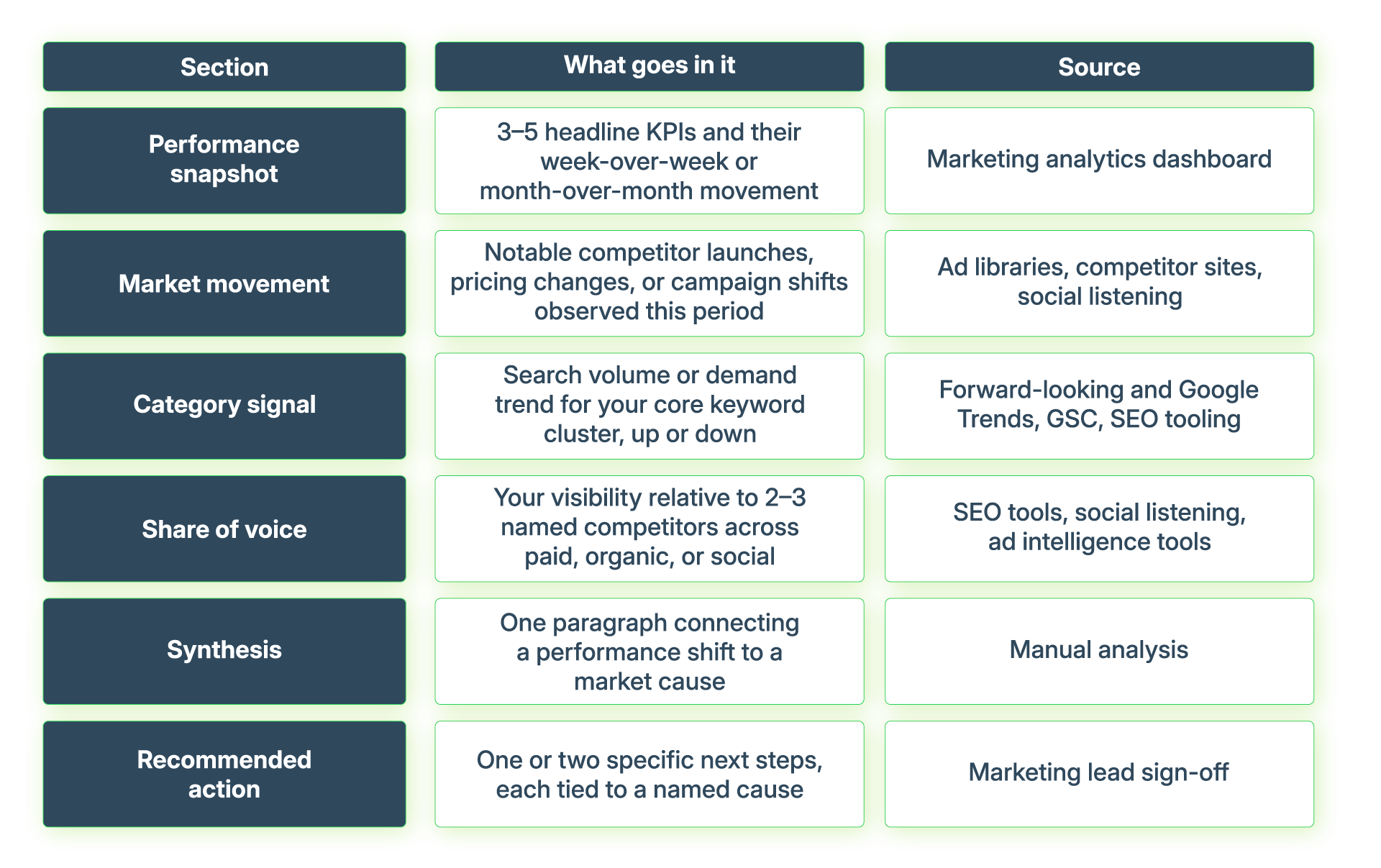
Keep this to one page. The goal is not exhaustive competitive research, it is a repeatable habit that stops your team from reading performance data in a vacuum.
The Hurree insight pattern: Common mistakes you can avoid
Even teams that understand the distinction in theory tend to fall into the same operational traps.
Mistake #1: Calling analytics "intelligence" in leadership reporting
- Operational problem: A performance dashboard gets relabeled "Marketing Intelligence Report" in the slide title, but the content is entirely internal metrics.
- Big-picture consequence: Leadership starts expecting competitive and market context in every report, and is quietly disappointed when it never arrives. Trust in the report format erodes.
- Why it's overlooked: "Intelligence" sounds more strategic than "analytics," so the label gets upgraded without the content changing.
- The fix: Rename the report accurately, and add even a small market-signal section before using the word "intelligence" in a title.
Mistake #2: Building the intelligence layer as a one-off project
- Operational problem: A team runs a thorough competitive analysis once a year, usually ahead of annual planning, then never revisits it.
- Big-picture consequence: By the time the next budget cycle arrives, the competitive landscape has moved and the analysis is stale. Decisions get made on outdated assumptions.
- Why it's overlooked: Competitive research feels like a project with a start and end date, rather than an ongoing input like a dashboard.
- The fix: Treat intelligence gathering as a recurring cadence, monthly or quarterly, with a named owner, not an annual event.
Mistake #3: Reading analytics and intelligence in separate meetings
- Operational problem: The performance review happens on Monday. Competitive updates get shared in a separate Slack channel or a different meeting entirely, days apart.
- Big-picture consequence: Nobody connects a metric shift to its market cause in real time. By the time someone notices the pattern, the window to react has closed.
- Why it's overlooked: The two data sets live in different tools, owned by different people, so they naturally get discussed separately.
- The fix: Put both in front of the same audience at the same time, even briefly. A one-page synthesis section, reviewed alongside the dashboard, closes this gap.
4 Strategic takeaways for marketing leaders
- Audit your current reporting: Look at your last three "intelligence" reports. If none of them reference a named competitor, a market trend, or an external benchmark, you are producing analytics under the wrong label, and your broader marketing strategy is missing a critical input.
- Assign ownership: Analytics usually has a clear owner. Intelligence often does not. Name someone, even part-time, responsible for the external signal layer.
- Standardize the synthesis step: Build the one-paragraph "here's why this moved" habit into your existing reporting cadence, rather than treating it as a separate exercise.
- Centralize both layers where possible: The less time your team spends manually stitching internal dashboards to external research, the more consistently the synthesis step actually happens.
Hurree: Where analytics and intelligence meet
Everything above sounds straightforward in principle. In practice, most marketing teams struggle because their marketing analytics already lives across a dozen disconnected tools, before external market signals even enter the picture. Layering intelligence on top of a fragmented analytics stack multiplies the manual work instead of simplifying it.
The most significant barrier to building a real intelligence practice isn't a lack of data; it's a profound lack of clarity in the analytics layer underneath it, often because the underlying marketing tech stack was never built with that clarity in mind.
Hurree is the unifying analytics intelligence layer that solves this.
By centralizing your scattered performance data into one environment, Hurree gives your team a clean, trustworthy analytics foundation, freeing up the time and attention needed to actually build the intelligence layer on top of it. We provide:
- Up-to-date visibility: Build unified dashboards that display your true, de-duplicated marketing performance across every channel, instantly.
- Automated insights: Our AI analyst constantly monitors your cross-platform data, proactively flagging performance shifts the moment they happen, the exact trigger point where intelligence should kick in.
- Seamless collaboration: Create complete transparency across your team with shared views, so the synthesis step happens in the same room as the metrics.
- No-code connectivity: Connect your entire stack in minutes with our library of pre-built connectors for every major CRM, BI, and advertising tool on the market.
You cannot build a strong intelligence practice on top of a shaky analytics foundation. Get the foundation right first.
See Hurree in Action → Book Your Demo Today
FAQs: Marketing analytics vs marketing intelligence
Is marketing intelligence the same as competitive intelligence?
Competitive intelligence is a subset of marketing intelligence. Marketing intelligence is broader, it includes competitor activity, but also category-wide search trends, industry benchmarks, regulatory shifts, and macro market conditions that affect your strategy even without a named competitor involved.
Do I need a dedicated tool for marketing intelligence, or can I build it manually?
Small teams can start manually, tracking competitor ad libraries, pricing pages, and search trend tools on a monthly cadence is enough to begin. As the practice matures, dedicated competitive intelligence and social listening tools reduce the manual research load, but the habit matters more than the tooling at the outset.
Which should I build first, analytics or intelligence?
Analytics first. You cannot productively interpret market signals if you do not have a reliable, centralized view of your own performance. Teams that try to build intelligence on top of fragmented, unreliable analytics tend to produce reports nobody trusts.
How often should a marketing intelligence report be updated?
Monthly is the minimum for most B2B and B2C marketing teams. Fast-moving categories with frequent competitor activity, such as SaaS or ecommerce, often benefit from a lighter bi-weekly check paired with a deeper monthly synthesis.
Can marketing intelligence data be automated the same way analytics dashboards are?
Partially. Structured external data, ad spend estimates, search trend volume, share of voice, can be pulled into dashboards automatically through various tools, and AI-driven marketing analytics is making this increasingly reliable. Qualitative signals, like a competitor's messaging shift or a new positioning angle, still require a human to read and interpret, which is why the synthesis step in the signal stack cannot be fully automated.

