

Completing a competitor analysis is just part of life as a marketer. Whether you conduct this process monthly, quarterly, or before each new campaign, you need to reassess your position within the market, and in comparison to your competitors, to gain and maintain success with your marketing strategy.
Conducting a competitor analysis involves researching, categorising, and analysing companies that you deem to be a threat to your prosperity. Delving into the strengths and weaknesses of rival brands helps you build up the insightful data necessary to design winning campaigns.

Benefits of Competitor Analysis
There are several additional benefits of frequently conducting an in-depth analysis of your potential competitors, both direct and indirect:
- Gain a better understanding of the market you operate within
- Learn more about how your target audience view your brand and its competitors
- Predict future opportunities for growth and expansion by identifying market gaps
- Identify product and feature development horizons
- Become more competitive with pricing
- Foresee threats arising from indirect competitor crossover
Like most modern marketing activities, your competitor analysis can be made more accessible by harnessing marketing technology. There are millions of tools out there that serve multiple purposes, but here are a few useful tools that are particularly favoured by the Hurree team.
Competitor analysis vs. competitive intelligence: A quick clarification
The terms are often used interchangeably, but they are not the same thing:
- Competitor analysis: A structured comparison of specific rival companies across defined dimensions such as product, pricing, marketing, and market share.
- Competitive intelligence: The broader, ongoing practice of gathering, analysing, and acting on information about competitors, customers, and the wider market environment.
- Benchmarking: The process of measuring your own performance against a competitor's, or against an industry standard, to identify gaps and improvement areas.
In practice, the tools below serve all three activities. Competitor analysis is a discrete project; competitive intelligence is the discipline; benchmarking is one of the outputs.
Competitor analysis tools you need in your marketing stack
Market research tools
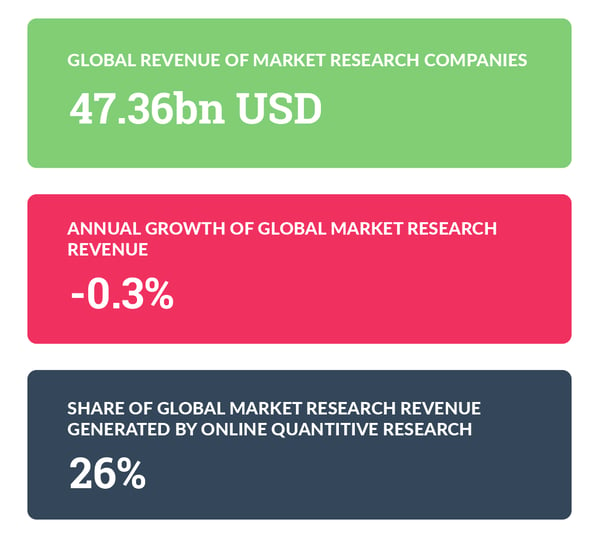
Carrying out market research is a crucial part of your competitor analysis; in fact, it’s step number one. If you don’t understand the market you operate within, you’re going to be on unsteady ground when it comes to understanding your competitor’s motivations and actions.
Source: Statista
The market research industry is big business, so depending on which company you use, things can get pricey. If you’re on the market for something that doesn’t break the bank, however, these tools can help:
Pew Research Centre
This ‘nonpartisan fact tank’ exists to inform public and business opinion on attitudes, trends, and issues impacting the world around us. Covering everything from demographic trends to environmental occurrences and technological trends, the Pew Research Centre (PRC) is a non-profit, non-advocacy organisation providing independent and objective insights into the global market.
Here’s an example of some demographic trend reporting carried out by the PRC on Gen Z:

Google Shopping Insights
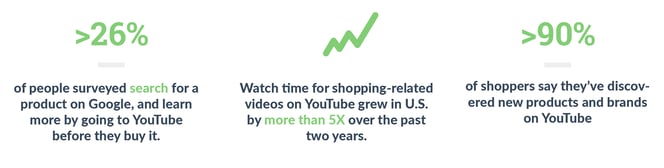
Shopping as we used to know it has changed, it’s evolving pretty much every day with each new hurdle the modern world throws at it. That’s why Google Shopping Insights (GSI) is an essential tool to have in your arsenal. Google Shopping Insights is used by retailers to calculate consumer interest in products. Analysis with GSI can operate on a localised, regional, or national scale, enabling you to access hyper-accurate data relating to your market.
Source: Think With Google
Customer feedback tools
Identifying who your competitors are is a crucial part of your competitor analysis, and your customers are the key to unlocking this secret. During their customer journey, consumers will have researched and analysed various options before landing on your business and products. Therefore, they have a great perspective on the market offerings and sometimes can even identify competitors that you haven’t considered or were unaware of.
SurveyMonkey

Source: SurveyMonkey
The online survey generation tool is trusted by companies worldwide to design, launch, and analyse customer surveys. You can create long-form questionnaires, quick quizzes, or polls that harness data to give you a real insight into your audience. SurveyMonkey provides expert sample questions to help guide and inform your questionnaires to ensure you get the best results, and their easy to use templates can be customised to suit your brand’s style.
Instagram polls
If your brand’s Instagram has a solid following of engaged customers, then using this platform can be a fun and creative way to gather information on competitors. There are nearly 1 billion monthly Instagram users globally. A lot of them belong to young age demographics, so conducting Instagram polls is a modern twist on stuffy old customer surveying practices. Polls can be conducted in the Stories section of Instagram and can be formatted as yes/no questions, multiple-choice questions, or questions with a feedback text box. Creativity is essential here, so make sure you put effort into the design and imagery of your Stories - the more eye-catching, the better.

Source: SurveyAnyplace
Operational tools
Recording the ins and outs of your competitor’s business is crucial intel. You need to consider:
- How much funding they have as that will impact their marketing budgets
- How big their team is, as that will affect the workforce they have to compete with you
- Where their HQ is based and how many store locations are operating as this will influence the geographic areas they target.
Crunchbase
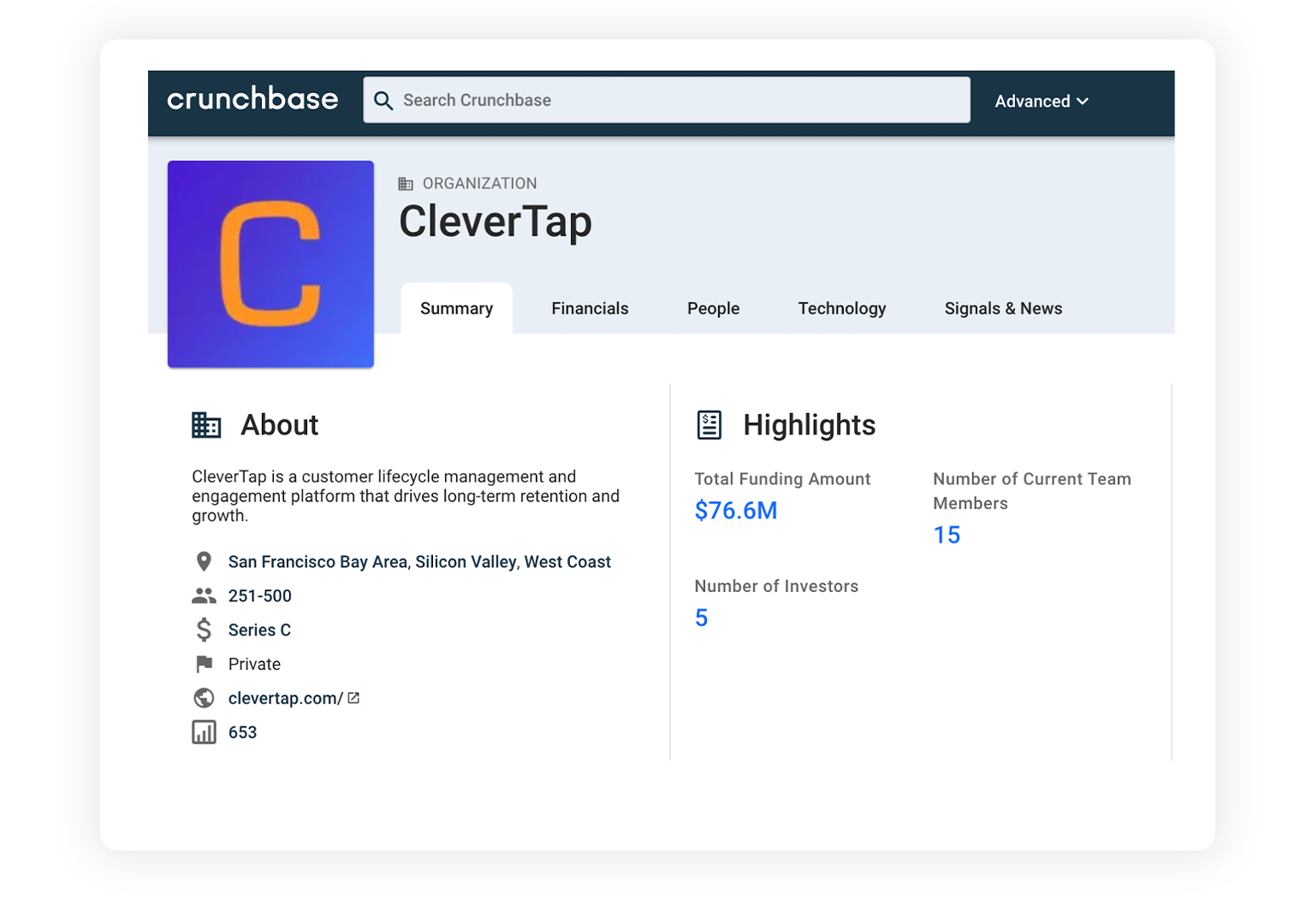
Crunchbase is a one-stop-shop for all of your operational competitor data; its main aim is to provide professionals and investors with a network to find innovative companies and connect them with their owners. It’s also useful for snooping on your competitors - score!
A simple public Crunchbase search of a company name will provide you with a company summary, financial information, employee details, technology usage, and any recent news or updates from that company. Plus, with Crunchbase Pro, you can monitor your competitors with real-time alerts.
Source: Crunch Base
SEO tools
Source: Small Biz Trends
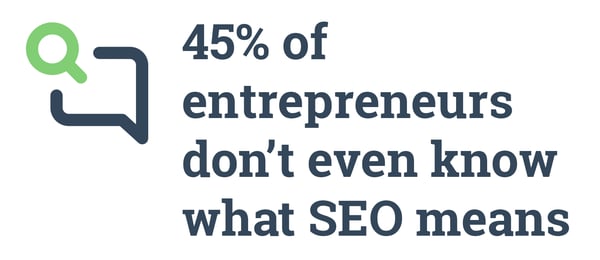
We live and work in a digital world; this means that your offline competitors aren’t always the same as your online competitors. Online competitors are defined as the companies or websites that compete for the same traffic as you by ranking for the corresponding keywords. A quick search of your company’s chosen keywords in Google’s SERPs (Search Engine Results Page) will show you where you rank (if you’ve made it to page 1 already) and with whom you’re competing.
Ahrefs Backlink Checker
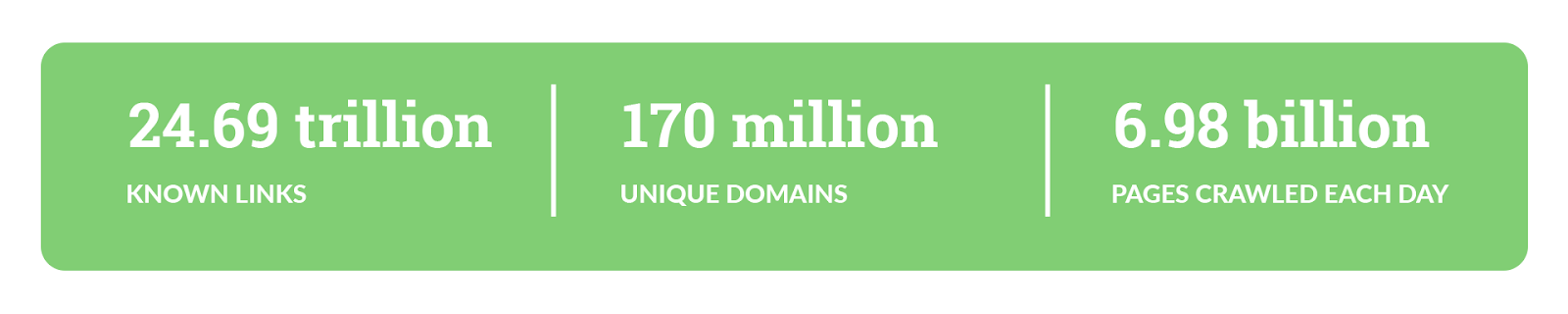
Backlinks are a crucial part of any SEO strategy; this element is also known as ‘off-page SEO.’ Building a strong backlink profile influences the DA (Domain Authority) of your website. Understanding your competitors’ backlink profile, who links to them, and what content is gaining them links, is crucial when it comes to stealing their traffic. Ahrefs backlink checker is the 2nd most active web crawler after Google, so they have the most significant backlink profile in the industry.
Source: Ahrefs Backlink Checker
SISTRIX Visibility Index
Measuring how successful your competitor’s websites are in terms of visibility is a vital part of your SEO competitor analysis. The SISTRIX Visibility Index has been collated from millions of data points, combining the number of keywords a site ranks for with the search volume and click-through-rate of those keywords. It is a gold standard of measuring success for search engine optimisation and now captures both desktop and mobile visibility. You can compare your competitor’s overall digital visibility to your own and find out where you need to improve.
Traffic & marketing stack tools
Understanding the impact of your competitor’s marketing strategy on search trends and consumer behaviour is essential. For example, if you monitor the search volume of your competitor’s brand name over time, you will be aware of the scale of their increased traffic when they launch a new product or campaign. This means you can readily understand how that impacts your website’s traffic.
Google Trends
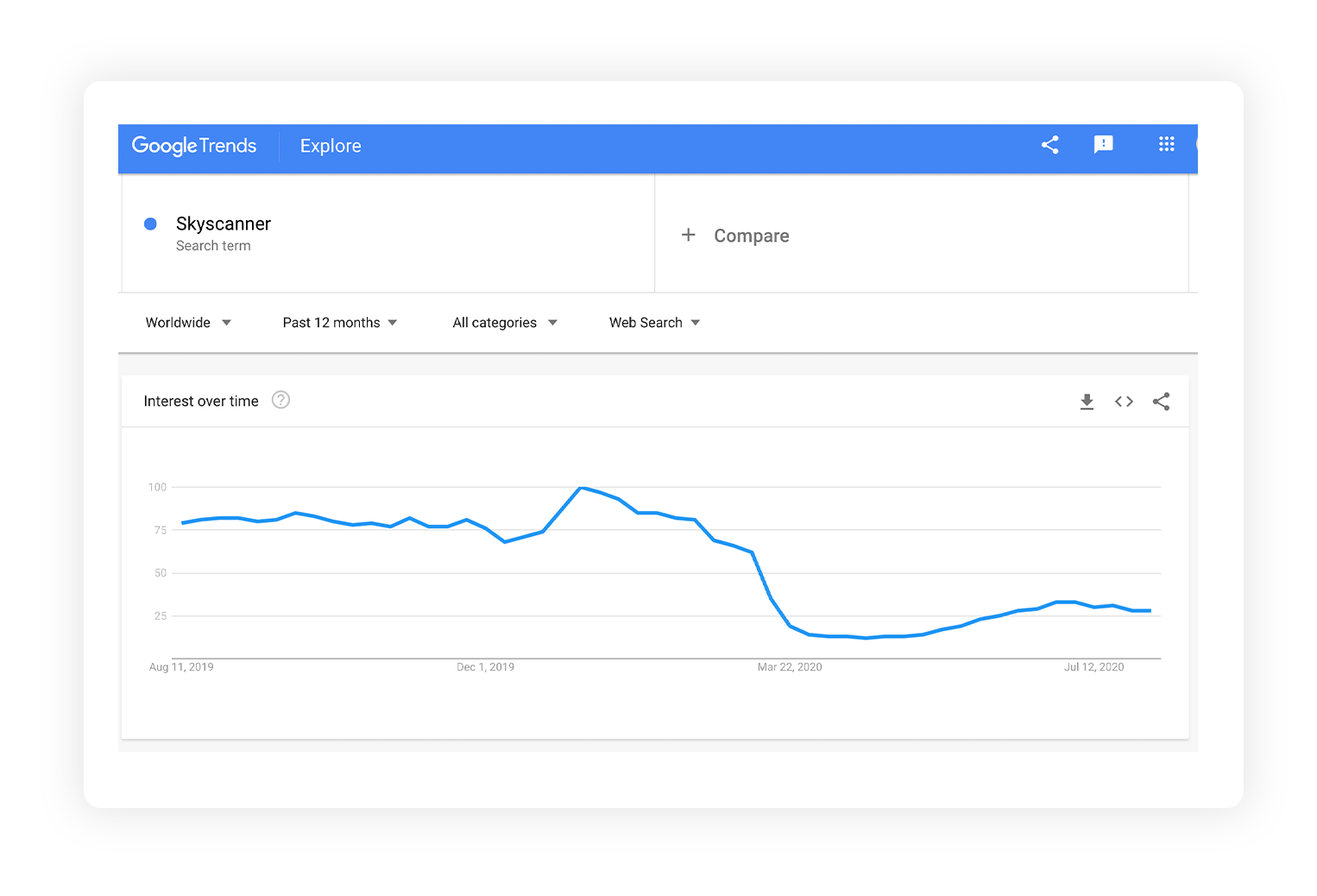
Want to find out how many people are searching for your competitors compared to you? Or how about where in the world your competitor is gaining the most traction? Google trends deliver real-time data on consumer search interest in any brand name or keyword. You can track the increase or decrease in search volumes over time, which is a super useful way to keep track of your competitor’s popularity within the consumer market.
Source: Google Trends
SimilarWeb
Beyond the search results for your competitor’s brand name and keywords, you’ll also want to know how much traffic your competitor’s website is getting compared to your own. If you’re already working with Google Analytics, you’ll understand the power of traffic analysis; the problem is it’s limited to your site. SimilarWeb can help you dive into your competitor’s domain and deliver performance analysis data such as time spent on-page, traffic sources, and even mobile app traffic.

Content tools
Another pillar of a solid SEO strategy is quality content. It’s crucial to assess your competitor’s content to understand what types they’re producing, which stages of the buyer’s journey that their content serves, and whether you can identify any content gaps that you could potentially fill.
Buzzsumo
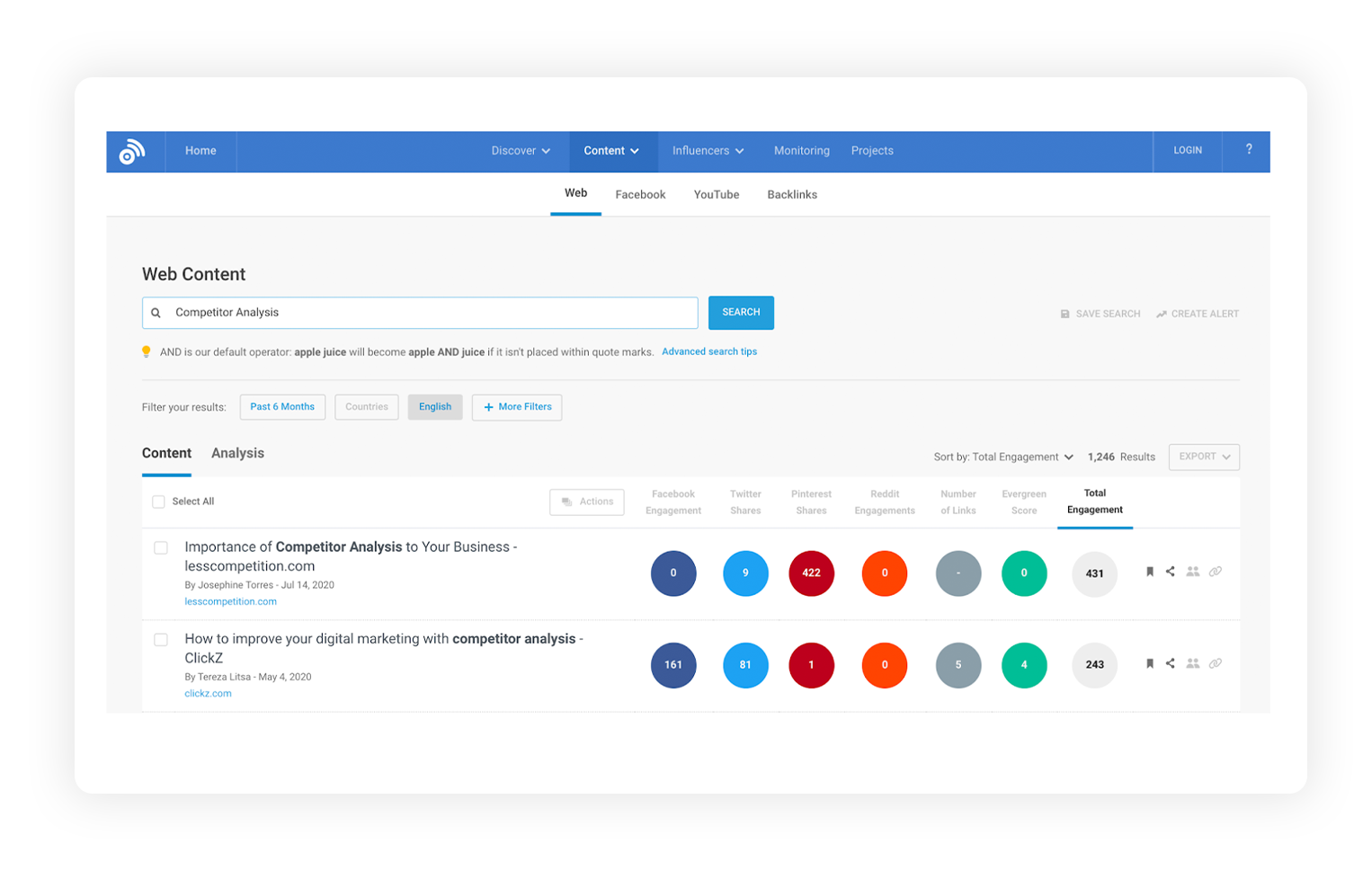
A powerful content research tool, Buzzsumo, helps marketing professionals learn from their competitors’ success. You can search by topic, keyword, or domain name to identify what types of content are popular on your competitor’s website, adjusting your content strategy based on this insight. Buzzsumo includes data from social media websites such as Facebook, LinkedIn, and Twitter, to show you which pieces of content receive high levels of engagement from their audiences.
 Source: Buzzsumo
Carrying out a competitive analysis may seem like a daunting task when you first begin. Still, there are many tools out there that can help you streamline the process, saving you time and energy to focus on your overall marketing strategy and customer needs.
Remember that competitor analysis is not a one-time affair; you will need to repeat it throughout your business lifecycle. Investing in tools that will make your life easier and your analysis more valuable will increase your competitive advantage, and, in turn, your chances of out-marketing your rivals.
PPC and paid-media competitor tools
The tools above focus on organic visibility, but a full competitive picture also requires understanding what your competitors are spending on paid channels. PPC competitor tools reveal which keywords rivals are bidding on, their estimated ad spend, ad copy variations, and landing page strategies. Common categories include:
- Search ad intelligence: Semrush, SpyFu, and iSpionage surface competitor keywords, ad copy history, and estimated monthly PPC budgets.
- Display and social ad libraries: The Meta Ad Library and Google Ads Transparency Center provide direct, free access to competitor ad creative currently running.
- LinkedIn Ad Library: Useful for B2B marketers monitoring how rivals target industries, job titles, and company sizes.
Reviewing paid strategies alongside organic ones prevents the classic mistake of assuming a competitor's traffic is entirely earned when a large share is actually bought.
AI-powered competitor analysis
Machine learning has changed what a "competitor analysis tool" can do. Where earlier tools reported historical data, AI-native tools now generate insights, predictions, and recommended actions:
- Automated competitor tracking: Tools such as Kompyte and Crayon continuously monitor competitor websites, pricing, and messaging changes, then flag significant shifts.
- Predictive share-of-voice models: Semrush and Similarweb Digital Intelligence now use AI to forecast likely traffic and ranking shifts based on early signals.
- Generative content gap analysis: AI can compare your content library against competitors and suggest specific topics, angles, and formats you are missing.
- AI-search visibility monitoring: As buyers increasingly ask AI assistants for recommendations, new tools monitor whether your brand (versus competitors) is being cited inside AI-generated answers.
For a wider view of how AI fits into modern marketing operations, see our companion pieces on strategies for AI-driven business success and measuring the ROI of AI in marketing.
Benchmarking: Turning competitor data into performance targets
Collecting competitor data is only half the job. Benchmarking is the discipline of translating that data into performance targets you can actually act on. A useful benchmarking workflow looks like this:
- Pick the right competitors: Choose two to five direct competitors and one aspirational competitor operating just above your tier.
- Choose the metric set: Traffic, keyword coverage, share of voice, backlink profile, engagement rates, and paid spend are the most common.
- Set a cadence: Monthly for fast-moving metrics such as social engagement, quarterly for backlink and ranking profiles.
- Define the gap: Distance between your current performance and the competitor median or the aspirational competitor.
- Convert to targets: Translate the gap into a specific, time-bound KPI for the team.
For a deeper walk-through on turning raw data into targets, see our guide on how to analyse data step by step.
Comparison at a glance: Which tool for which job
Use this quick-reference table when scoping your stack:
|
Tool |
Primary use case |
Best for |
Free tier? |
|---|---|---|---|
|
Pew Research Centre |
Market and demographic research |
Any team needing macro trend data |
Yes |
|
Google Shopping Insights |
Product-level consumer interest |
Retail and ecommerce |
Yes |
|
SurveyMonkey |
Customer feedback and surveys |
All teams |
Limited free plan |
|
Instagram Polls |
Lightweight audience research |
B2C brands with engaged followers |
Yes |
|
Crunchbase |
Company profile and funding intel |
Sales, strategy, competitive research |
Free basic; Pro paid |
|
Ahrefs Backlink Checker |
Backlink profile analysis |
SEO teams |
Limited free checker; full suite paid |
|
SISTRIX Visibility Index |
Visibility benchmarking |
SEO teams tracking share of visibility |
Paid |
|
Google Trends |
Search-interest trend tracking |
Any marketer monitoring brand or keyword momentum |
Yes |
|
SimilarWeb |
Traffic and engagement analysis |
Marketing and strategy teams |
Limited free tier; paid plans |
|
Buzzsumo |
Content performance research |
Content and social teams |
Limited free trial; paid plans |
Integrating competitor data into your wider stack
A tool that produces a PDF once a quarter is not competitive intelligence. The competitor data that moves the needle is the data that flows into the systems your teams already use every day. Practical integration patterns:
- BI dashboards: Platforms such as Hurree can pull competitor traffic, keyword, and share-of-voice data into the same dashboard as your own marketing performance.
- CRM enrichment: Feed competitor-mention data (from Buzzsumo, Crayon, or Kompyte) into your CRM so sales reps see it on the account record.
- Marketing automation: Trigger sales alerts when a competitor makes a pricing or messaging change relevant to an open opportunity.
- Slack or Teams alerts: Route real-time competitor mentions to a dedicated channel so the team acts on signals within hours, not weeks.
The goal is a single source of truth where competitor data lives alongside your own performance data.
How to choose the right tool for your business
A structured approach helps prevent overspending on features you will not use:
- Define the primary job: SEO, content, paid, product, or funding intelligence. Do not buy a Swiss Army platform if you only need one blade.
- Match to team size and maturity: A two-person marketing team is better served by two focused free tools than by a single enterprise suite.
- Check integration: Does the tool export cleanly to your BI dashboard, CRM, and reporting stack? If not, factor in the manual work.
- Trial before you commit: Nearly every paid tool listed above offers a free trial. Use the trial to run one real competitor analysis end-to-end.
- Review annually: The martech space consolidates quickly. What was best in class two years ago may now be surpassed by a newer entrant.
For teams still working out who to benchmark against, our post on identifying your target audience is a useful starting point, since your target audience and your competitor set are directly linked.
Frequently asked questions
What is a competitor analysis tool?
A competitor analysis tool is any software that helps you gather, organise, and interpret information about rival companies — including their website traffic, SEO performance, paid strategies, content, pricing, funding, and customer sentiment. Together, these tools turn scattered public information into actionable insight.
What is the difference between competitor analysis and competitive intelligence?
Competitor analysis is a structured, usually periodic comparison of specific rivals. Competitive intelligence is the ongoing discipline of gathering and acting on information about competitors, customers, and the wider market. The tools overlap; the intent differs.
What are the best free competitor analysis tools?
Google Trends, Google Shopping Insights, Pew Research Centre, the Meta Ad Library, the Google Ads Transparency Center, and free tiers of Similarweb, Ahrefs Backlink Checker, and Crunchbase provide meaningful capability at zero cost.
Which competitor analysis tools are best for SEO?
Ahrefs, Semrush, SISTRIX, and Similarweb Digital Intelligence are the most widely used. Choice depends on whether your priority is backlinks (Ahrefs), keyword and paid data breadth (Semrush), visibility indexing (SISTRIX), or holistic traffic behaviour (Similarweb).
Which tools are best for small businesses on a tight budget?
Combine free tools strategically: Google Trends for demand, the Meta Ad Library for competitor creative, Crunchbase basic for company intel, and the free tiers of Ahrefs and Similarweb for SEO and traffic. This stack costs nothing and covers most of the ground a small team needs.
How do I use AI to improve competitor analysis?
AI helps in three main ways: Continuous monitoring of competitor changes (Crayon, Kompyte), predictive modelling of traffic and ranking shifts (Semrush, Similarweb), and content gap analysis that suggests specific topics to cover. Increasingly, AI-search visibility tools also track whether your brand is cited inside AI-generated answers.
How often should I run a competitor analysis?
A full deep-dive quarterly is standard for most teams. Continuous monitoring, using alert-based tools, should run in the background between deep-dives so you never miss a significant competitor move.
What is benchmarking in competitor analysis?
Benchmarking is the process of measuring your own performance against a competitor's or against an industry standard, to identify gaps and set improvement targets. It is one of the most valuable outputs of competitor analysis because it converts data into specific KPIs.
Do I need PPC competitor tools if I only run organic marketing?
Yes. Understanding competitor paid activity gives context for their organic traffic and reveals which keywords, offers, and audiences they consider valuable enough to pay for — useful signal for your own organic strategy.
How do competitor analysis tools integrate with a BI or reporting stack?
The most valuable integrations flow competitor data into your existing dashboards, CRM, and alert systems so teams act on it in real time. A BI platform such as Hurree can consolidate competitor metrics alongside your own performance data in a single view.


Share this

How to Complete Your First Competitor Analysis

Maximize your Keyword Research with SEO Competitor Analysis
-3.png)