It’s a familiar conundrum for marketers - we know brand awareness is important enough to invest in, but proving ROI is nearly impossible, isn’t it? Well, that all depends on how you look at it. While the impact of brand awareness has been and will continue to be debated, there is no denying it’s something marketers put a lot of stock in (and, in this marketer’s opinion, can have an impact on your marketing bottom line when done right).
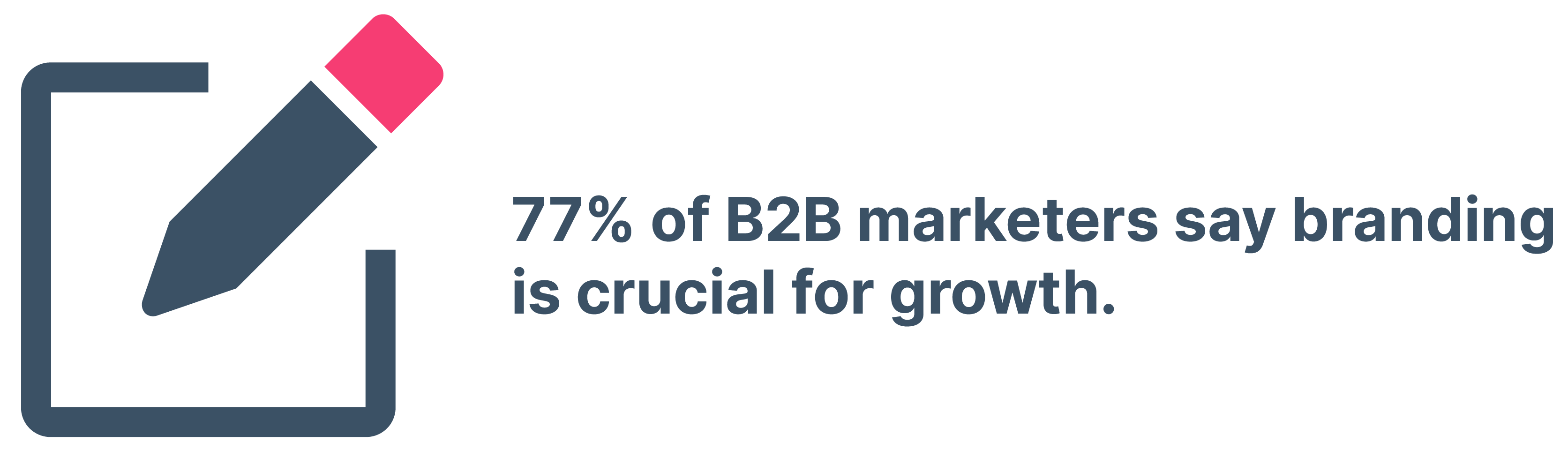
Source: Circle Research
Brand awareness is also a critical building block of brand equity – the overall value of your brand in the minds of customers. Strong awareness tends to:
- Increase trust and preference when a buyer is comparing options
- Improve performance of your paid and organic campaigns over time
- Lower customer acquisition costs because people recognise you faster
This is why choosing the right brand awareness metrics and tracking them consistently is so important. It’s not just about “being known,” it’s about building a brand that makes every other marketing activity more effective.
What is brand awareness?
Brand awareness is the extent to which people are able to recognise or recall a brand in different circumstances. In other words, it’s how recognisable your brand is to your target audience and the public at large. It’s one of the key metrics in measuring how successful brand campaigns are and can be an important aspect in making sure your marketing team is getting it right.
Specifically, part of getting brand awareness right is benchmarking and measuring it. Just like with any marketing initiative, getting the right data and using it to analyse how your brand awareness is impacted by your campaigns is the only way to see what you’re doing right (or wrong).
But as we noted above, this can be a little bit tricky. How do you measure people’s knowledge of you? And how do you measure ROI on brand awareness activities?
Put simply, brand awareness has three main components:
- Recognition: “Have I seen or heard of this brand before?”
- Recall: “Can I name this brand without being prompted?”
- Association: “What comes to mind when I think about this brand?”
The brand awareness metrics you choose should help you understand all three, not just how many people saw your logo, but what they remember and how they feel about you.
Brand awareness vs. recognition, recall, loyalty, and equity
The terms are often used interchangeably but describe different things. Understanding the distinctions makes measurement far sharper:
- Brand awareness: The umbrella term for whether people know your brand exists.
- Brand recognition: Aided identification. The consumer sees or hears the brand and thinks "I know this."
- Brand recall: Unaided identification. The consumer names your brand when asked about a category.
- Brand loyalty: Repeat behaviour and preference over time. Loyalty sits downstream of awareness.
- Brand equity: The total commercial value your brand carries — the sum of awareness, associations, perceived quality, and loyalty.
Awareness is the entry point; equity is the outcome. The 7 metrics below help you measure the awareness layer accurately so it feeds equity growth. For a wider view of the mistakes brands make on this journey, see our post on four common mistakes when building your brand.
Metrics to measure brand awareness
The first step is defining the metrics that will provide you with some idea of your brand awareness. That’s where this blog comes in. We’ve put together a list of some of the key things you can benchmark, track, and measure to prove the efficacy of your campaigns and see how well-known your brand actually is.
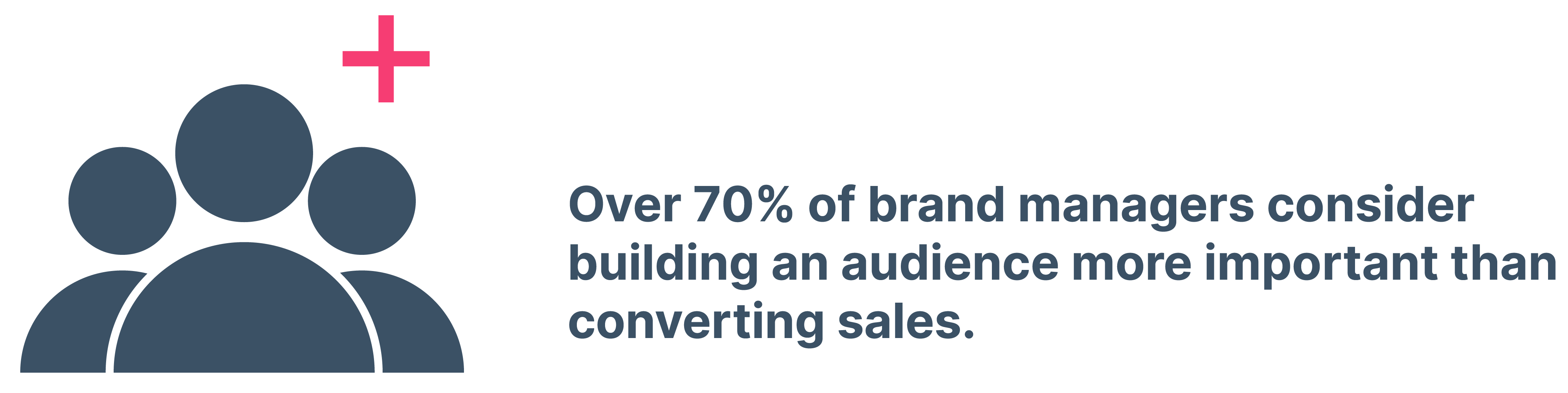
Source: Bynder
Think of these as your core brand awareness metrics. Together they give you a fuller picture than any single number could. Later, we’ll look at how to bring them together in a brand awareness dashboard so you can monitor them in one place.
Brand awareness surveys
Direct feedback is the most straightforward way to gauge brand awareness. You’re essentially asking your target audience questions that should give you a good picture of how you’re doing. And when carried out regularly, tracking feedback via surveys allows you to monitor brand awareness over time and can be tied to specific marketing campaigns.
A few metrics to measure within these surveys include:
- Unaided brand awareness (brand recall): How many within your target audience recognise your brand without being prompted
- Aided brand awareness (brand recognition): This is the number of people who recognise your brand or company when prompted
What to add to your brand awareness dashboard:
- Unaided recall (%) by segment
- Aided recognition (%) by segment
- Trend lines over time, especially before/after major campaigns
Website traffic
Another basic but important way to measure brand awareness, website traffic shows how many people visit your site. This can be a great indicator of brand awareness, especially as it relates to specific marketing activities. Quite simply, increases in web traffic indicate better brand awareness.
It can be especially useful to look at direct traffic. This is the number of people who came to your website directly, meaning they knew your brand enough to type in your website without having to search for it. Any increase in this indicates more people are aware of your brand.
What to add to your brand awareness dashboard:
- Total sessions and users (overall traffic trend)
- Direct sessions and users (people who typed your URL or used bookmarks)
- Traffic to key “brand” pages such as home, about, and flagship product pages

Branded search volume
Branded search is anytime someone uses a branded term on a search engine. For example, whenever people search ‘Hurree’ or ‘Hurree Dashboards’. Branded search volume shows you the number of people who not only know who you are, but are searching for more information about you.
In other words, when your branded search volume increases it theoretically means that more people know about your business. This can be a great metric to measure when undertaking a specific brand awareness or PR campaign. While you can’t tie any individual searches directly back to a specific campaign, you can measure any fluctuations in searches as the campaigns progress.
What to add to your brand awareness dashboard:
- Impressions for branded keywords
- Clicks and CTR for branded keywords
- Comparison of branded vs non‑branded search traffic
Backlinks
Backlinks are when other websites on the internet link back to your own. They are a good indicator of brand awareness in that they show that other sites a. Have seen your content and b. Think it’s good enough to link to. Think of it as a vote of confidence.
It is also a good indicator of your ‘online reputation’ as backlinks are a direct factor in search engine rankings. The more backlinks you have, theoretically, the better you should be doing on sites like Google, which means more people are seeing your business and content.
What to add to your brand awareness dashboard:
- Number of referring domains
- Total backlinks from unique domains
- New backlinks gained over the last 30/90 days
Click-through rate
This is a very useful metric to track for a lot of reasons, but in terms of brand awareness it can be quite a telling stat if you know how to interpret it. When it comes to brand awareness, it can be an indicator how well known or well trusted you are. How? Well, people are choosing to click on your content rather than someone else’s. This one isn’t as directly related, but when you’re looking to measure the impact of specific campaigns or activities, increased CTR can be a great way to show that they’ve worked.
What to add to your brand awareness dashboard:
- CTR by campaign and channel
- CTR for brand campaigns vs purely performance campaigns
- Changes in CTR around awareness‑focused creative or messaging tests
Social media engagement
A lot of brand awareness activities are run via social media. Whether you’re using paid ads or organic means, you should not only be looking at who is seeing the content but also who is engaging with it. When we talk about engagement here, we mean things like: impressions, reach, likes, shares, replies, clicks, follows, etc. The exact engagement will depend on the platform you’re using.
These metrics allow you to see how people are talking about and engaging with your brand. Are the comments negative or positive? Do you have any industry influencers engaging with your content? These won’t give you the whole picture of your brand, but given 59% of the population is on social media, it should provide a good indication of where you stand with social users.
What to add to your brand awareness dashboard:
- Reach and impressions per platform
- Engagement rate (engagements / impressions)
- Brand mentions, tags, and hashtag usage
- Follower growth over time
Share of voice & impression share
These two metrics are similar to brand mentions on social media, but provide a bit more information.
- Share of voice (SOV): how much brand exposure you have compared to your competitors on different channels - news sites, blogs, forums, social media, and offline channels. It measures the online visibility of your brand in terms of the conversations taking place about your brand, including the number of mentions and tags etc. Basically, it’s how often your brand is mentioned when compared to others in your industry.
- Share of impressions (SOI): This is a paid search metric that tells you how often your ads were shown for a particular search when compared to your competitors. It’s also shown as a percentage.
When you combine these two metrics you can see both the quantity and quality of coverage. For instance, if your SOV is high but SOI is low, then your organic brand efforts are likely working well, but you may need to look at the factors that go into search engine performance.
What to add to your brand awareness dashboard:
- SOV vs top 3–5 competitors per channel
- Impression share for your core brand and category campaigns
- SOV/SOI trends before and after major brand initiatives
Proven tactics to grow brand awareness
Measurement is only half the job. Once your dashboard is in place, these are the tactics that consistently move the metrics upward:
- Consistent content publishing: Owned content on your blog, YouTube, and podcast builds discoverability and search authority over time.
- PR and thought leadership: Founder and executive presence in industry press, podcasts, and events lifts branded search and referring domains fastest.
- Partnerships and co-marketing: Joint webinars, research reports, and integrations expose you to adjacent audiences without paid acquisition costs.
- Community building: LinkedIn, Discord, Slack, or subreddit communities compound brand recall in ways paid channels rarely match.
- Paid brand campaigns: Awareness-optimised ads on Meta, LinkedIn, YouTube, and CTV lift aided recognition when combined with organic activity.
- Influencer and creator partnerships: Micro and niche creators drive stronger recall in a target segment than broad celebrity endorsements.
- Signature research or data: Original research, benchmark reports, and industry surveys generate backlinks, mentions, and SOV in a single asset.
For a wider view of how these tactics fit into a full marketing plan, see our guide to the components of a marketing strategy.
Common challenges in measuring brand awareness
Even with the right brand awareness metrics, measurement is not always straightforward. Some common challenges include:
- No single “brand awareness score”
Brand awareness lives across multiple indicators – surveys, social, search, web traffic, PR coverage. You need to look at them together rather than chasing one number. - Attribution and time lag
Brand campaigns often influence buying decisions weeks or months later. It’s hard to say “this sale came from that awareness ad,” which can make ROI conversations tricky. - Vanity metrics
Focusing only on big numbers like impressions or followers without context can be misleading if they don’t correlate with recall, recognition, or downstream results. - Data silos
Awareness data often lives in separate tools: analytics, social platforms, survey tools, PR trackers. Without a unified view, it’s difficult to see the full impact.
This is where a well‑designed brand awareness dashboard makes a real difference. It helps you combine multiple signals, track trends over time, and have more informed conversations about the value of brand‑building activities.
Case studies of successful brand awareness campaigns
Three tight examples of what strong brand awareness campaigns look like in practice:
- Duolingo's TikTok playbook: The owl mascot on TikTok lifted Duolingo from an app most people had used briefly to a cultural touchpoint. The account grew past 12 million followers and drove sustained lifts in branded search and app installs — proof that character-led social content can outperform traditional paid awareness at a fraction of the cost.
- Liquid Death's category-defining branding: By positioning canned water as a rebellious lifestyle brand, Liquid Death became a widely recognised name in under five years, with strong recall and social share of voice built almost entirely through creative content and community rather than mass media buys.
- Notion's community-led growth: Notion built brand awareness through a template gallery, ambassador programme, and creator community, driving branded search growth that outpaced most enterprise SaaS competitors and lowered its customer acquisition cost meaningfully.
The pattern across all three is the same: A distinctive point of view, consistent creative execution, and community amplification. For a wider look at the KPIs that would show these campaigns working on your own dashboard, see our post on the 40 most important KPIs for marketers.
How AI is reshaping brand awareness measurement
Machine learning has changed both what and how we measure brand awareness:
- Automated brand mention monitoring: AI tools such as Brandwatch, Brand24, and Meltwater track mentions across news, social, forums, and podcasts in real time — replacing manual media monitoring.
- Sentiment and emotion analysis: Modern NLP models score brand mentions on sentiment, emotion, and intent, moving beyond raw mention counts to qualitative signals.
- AI-search visibility monitoring: New tools (Profound, Otterly, AthenaHQ) track whether your brand is being cited inside AI-generated answers on ChatGPT, Perplexity, and Google's AI Overviews — an increasingly important awareness signal.
- Predictive brand equity modelling: ML models forecast how current awareness signals are likely to translate into future purchase behaviour and market share.
- Generative brand-safe creative: AI tools now generate on-brand creative variants at scale, letting teams test dozens of awareness angles for a fraction of previous production cost.
The practical shift is that brand awareness measurement is moving from monthly retrospective reporting to always-on, predictive tracking. For a wider view of measuring AI's return, see our companion piece on measuring the ROI of AI in marketing.
How to measure brand awareness
These KPIs are meant to provide a comprehensive overview of how well your brand is known across the digital landscape. Once you define what you want to measure, you have to find the right tools. In most cases, you’ll be able to use the native functions within the platform like Twitter or Facebook, and Google Analytics is a powerful tool. However, to properly benchmark and measure progress, we would recommend a dashboard tool, like Hurree.
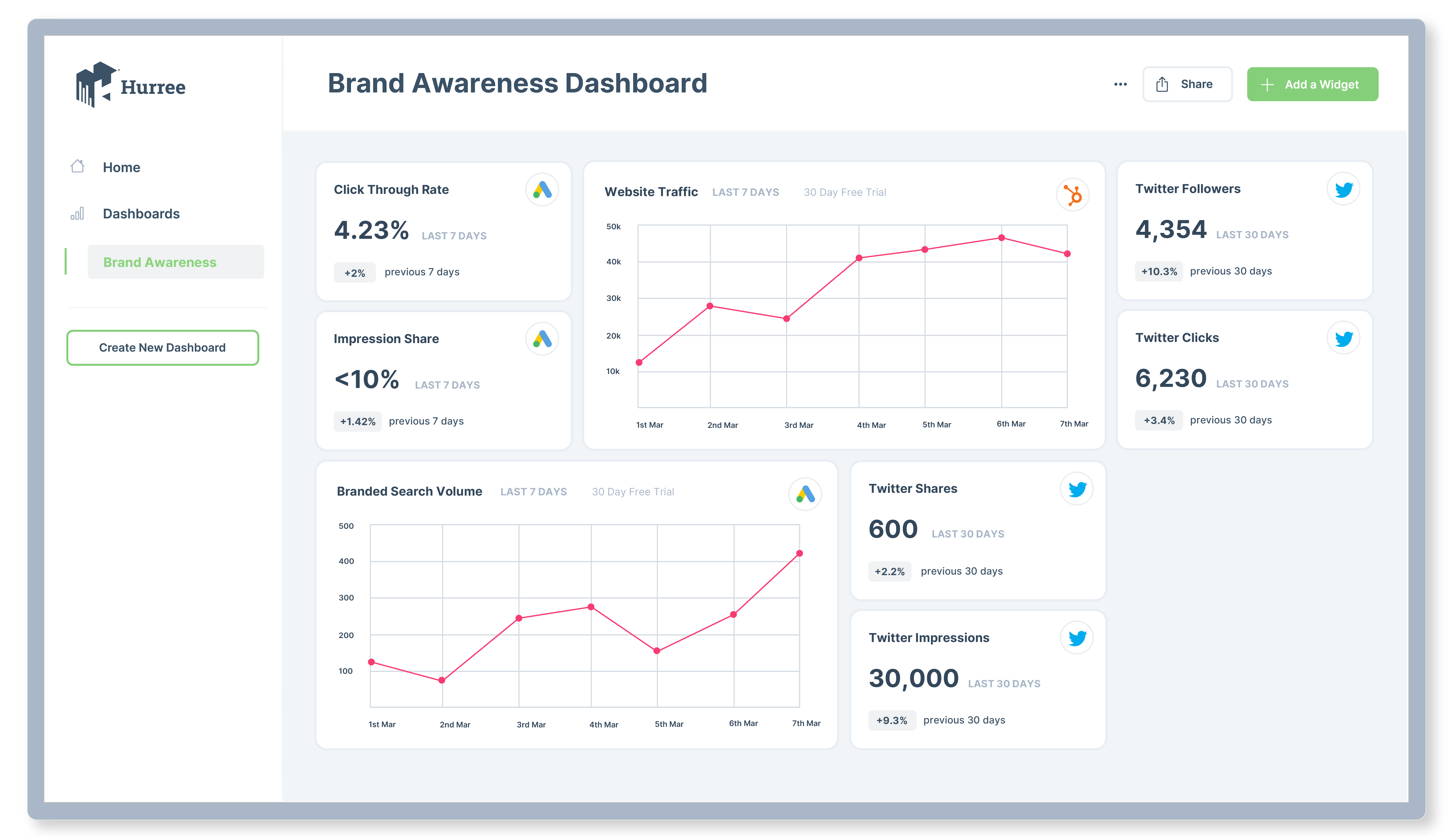
A dashboard will give you a snapshot view of your most important KPIs and allow you to see in real-time how you’re doing, meaning you will be able to track, measure, and report on brand awareness and finally show the ROI of your branding activities.
The ROI of brand awareness (especially for small businesses)
Brand awareness ROI often looks weak in a single quarter and strong over 12–24 months. Three compounding effects drive this:
- Lower CAC over time: As awareness grows, more prospects arrive already familiar with your brand, reducing the paid spend needed per acquisition.
- Higher paid-media efficiency: Retargeting and lookalike audiences perform measurably better when the seed audience already recognises the brand.
- Higher win rates and price power: Familiar brands close deals faster and can command higher prices at similar conversion rates.
For small businesses, the practical implication is that brand investment should be measured on a rolling 12-month horizon, not a single quarter. Track branded search growth, direct traffic growth, and CAC trend as leading indicators — these move well before revenue does. For a fuller view of how to compare marketing return metrics, see our post on the differences between ROAS and ROI.
Building a brand awareness dashboard with Hurree
Once you know which brand awareness metrics matter most to you, the next step is turning them into a practical brand awareness dashboard. In Hurree, that might look like:
- Survey widgets
- Unaided recall % and aided recognition %
- Comparison across segments or regions
- Website widgets
- Direct sessions trend
- Sessions on key brand pages (home, about, core product)
- Search widgets
- Branded keyword impressions and clicks
- Branded vs non‑branded organic traffic
- SEO widgets
- Referring domains and new backlinks over time
- Campaign widgets
- CTR for major awareness campaigns vs non‑brand campaigns
- Social widgets
- Engagement rate by platform
- Mentions, tags, and follower growth
- Competitive widgets
- Share of voice vs top competitors
- Impression share for your main brand campaigns
Bringing these into a single Hurree dashboard lets you monitor changes in brand awareness from one place, rather than jumping between tools. It also makes it easier to share a clear, visual story with stakeholders about how brand campaigns are performing.
A dashboard will give you a snapshot view of your most important KPIs and allow you to see in real-time how you’re doing, meaning you will be able to track, measure, and report on brand awareness and finally show the ROI of your branding activities.
Track and visualize your metrics in real-time with Hurree. Get started today and discover how to truly harness the power of analytics and transform your company reporting using cross-platform dashboards.
Frequently asked questions
What is brand awareness in simple terms? Brand awareness is the extent to which people recognise or recall your brand. It has three components — recognition (aided), recall (unaided), and association (what comes to mind).
What is the difference between brand awareness and brand recognition? Awareness is the umbrella term. Recognition is aided identification — the consumer sees your logo and thinks "I know this." Recall is unaided — they name your brand when asked about the category.
How is brand awareness different from brand loyalty? Awareness is whether people know your brand exists. Loyalty is whether they choose you repeatedly and prefer you over alternatives. Loyalty is downstream of awareness.
What are the best metrics to measure brand awareness? The seven core metrics: Brand awareness surveys (aided and unaided), website traffic (especially direct), branded search volume, backlinks, click-through rate, social media engagement, and share of voice or impression share.
What tools should I use to measure brand awareness? Google Analytics for traffic and direct sessions, Google Search Console for branded search, Ahrefs or Semrush for backlinks and share of voice, native platform analytics for social, and a BI platform like Hurree to consolidate everything into one dashboard.
How often should I measure brand awareness? Monthly for search, traffic, and social engagement metrics. Quarterly for surveys. Continuously for share of voice and brand mentions. Compare against baselines before and after major campaigns.
How does social media affect brand awareness? Social platforms are one of the highest-leverage channels for awareness because they combine reach, engagement, and community. Consistent creative and character-led content routinely outperform mass-media spending on aided and unaided recall.
What is a realistic ROI on brand awareness? Brand awareness typically shows compounding ROI: Lower CAC, higher paid-media efficiency, and improved conversion rates over 12–24 months. Single-quarter ROI is often flat or negative even when the long-term return is strong.
Can small businesses justify brand awareness investment? Yes. Small businesses benefit disproportionately because early brand equity lowers customer acquisition costs across every channel. Focus on branded search growth, direct traffic growth, and CAC trend as leading indicators.
How is AI changing brand awareness measurement? AI enables real-time mention monitoring, sentiment and emotion scoring, predictive brand-equity modelling, and AI-search visibility tracking — measuring whether your brand is cited inside AI-generated answers. Measurement is shifting from monthly retrospective to always-on, predictive tracking.


Share this

Measuring Content Marketing Success: Essential Metrics to Track

6 Benefits of KPI Reporting