

Ask three different tools how a campaign performed, and you will often get three different answers. Salesforce says one thing, Looker Studio from your agency says something else, and LinkedIn shows something else again. The totals can sit thousands of dollars apart, and when your CEO asks which campaign actually drove revenue last quarter, you are left guessing which source to trust.
This is what data silos cost. Not just the wasted spend on tools that never talk to each other, but the hours lost reconciling numbers and the quiet worry that whatever you report is off.
Buying software is easy. Making it talk to each other to generate a unified, truthful view of the customer journey? That is incredibly difficult.
In short
- A marketing tech stack (MarTech stack) is the integrated collection of software, platforms, and tools used by marketing teams to execute, measure, and optimize campaigns across the customer lifecycle.
- The maturity model: Stop duct-taping tools together. High-performing teams build integrated, predictive ecosystems powered by unified marketing analytics.
- The 5-layer architecture: Think of it like building a house. You must lay the foundation (Data and Execution) before you pick out the curtains (Visualization and Dashboards).
- The math matters: Knowing the exact formulas for MarTech ROI, Platform Utilization Rates, and Integration Costs is non-negotiable for modern marketing leaders.

What is a marketing tech stack?
At its core, a marketing tech stack is the digital infrastructure that brings your marketing strategy to life. It is the combination of SaaS products your team uses to attract, engage, convert, and retain customers.
Think of a single customer journey. Sarah clicks a Google Ad (Tool 1), reads a blog post hosted on your CMS (Tool 2), downloads an ebook via a form (Tool 3), gets placed into an automated email nurture sequence (Tool 4), and eventually has a meeting booked with sales in your CRM (Tool 5).
A true stack means these five tools communicate flawlessly. When Sarah books that meeting, the CRM instantly tells the advertising platform to stop wasting ad spend on retargeting her.
When your stack is broken, Sarah keeps seeing "Download our eBook!" ads three weeks after she already became a paying customer. It creates a disjointed customer experience and torches your advertising budget.
In 2026, the martech stack has evolved far beyond a basic email sender and a CRM. Driven by the integration of AI tools for marketing, robust Customer Data Platforms (CDPs), and Business Intelligence (BI) layers, it operates as the central nervous system of any data-driven company.
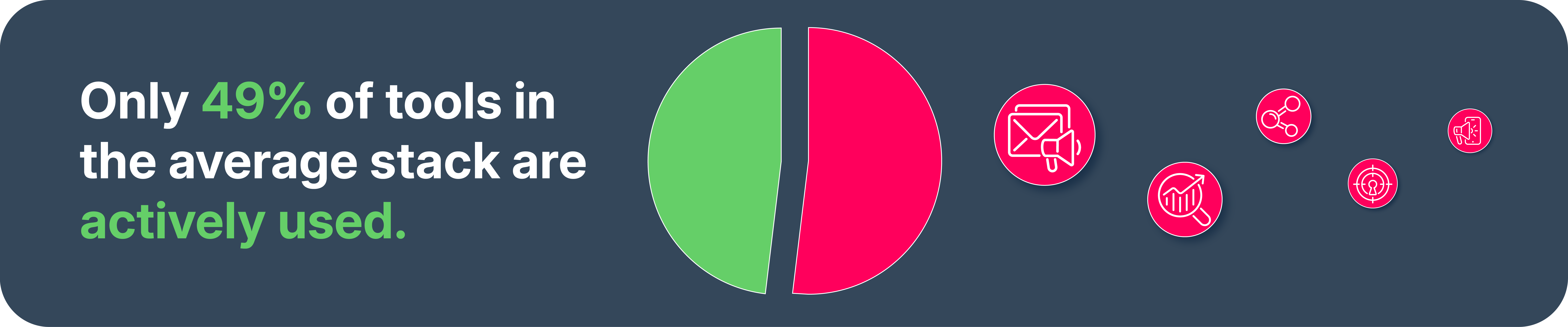 Source: Gartner
Why a cohesive tech stack matters (the operational reality)
Your tech stack dictates your team's agility, accountability, and survival.
For in-house marketing teams:
When tools don't integrate natively, your highly paid marketing strategists default to being data entry clerks. Imagine spending three days a month downloading CSV files from Meta, Google, and HubSpot, just to run VLOOKUPs in Excel to see if a campaign worked.
A structured stack eliminates this grunt work. It allows marketing leaders to transition from managing software subscriptions to managing a revenue engine. It provides the automated infrastructure needed to scale marketing reporting, defend your budget to the CFO, and pivot a campaign the moment a channel starts underperforming.
For marketing agencies:
Client retention is built on one thing: undeniable proof of ROI. Agencies that rely on a fragmented stack of disconnected tools end up sending clients conflicting reports and delayed insights. "Well, Facebook says we got 50 leads, but your CRM only shows 20." That is the exact conversation that gets an agency fired.
Conversely, agencies that utilize a unified, multi-channel marketing framework can provide clients with real-time, transparent dashboards. A streamlined tech stack is how an agency proves it has the operational maturity to handle enterprise-grade budgets.
The marketing tech stack maturity model
Let's look at the four stages of MarTech evolution. Be honest about where your team currently sits—most companies are trapped in the first two stages, drowning in subscriptions but starved of actual value.
Descriptive stacks: "The duct-tape era"
This is the baseline standard for nascent businesses. The stack consists of completely disconnected point solutions.
- The reality: You have Mailchimp for emails, Hootsuite for social, and a basic spreadsheet for leads. Nothing talks to anything else.
- The consequence: To build a single monthly report, an analyst has to manually pull data from five different platforms. Discrepancies run rampant, and nobody trusts the final numbers.
Diagnostic stacks: "The point-to-point era"
At this level, operations teams begin connecting tools directly to one another using native integrations or basic middleware like Zapier.
- The reality: Your LinkedIn Lead Gen forms finally sync directly into your CRM, and your CRM automatically triggers a welcome email sequence.
- The consequence: You eliminate the most tedious manual data entry, but the web of integrations becomes fragile. If Zapier breaks or an API updates, the whole system temporarily collapses.
Predictive stacks: "The centralized hub"
This is where modern marketing teams separate themselves from the pack. The stack is re-architected around a centralized database, usually a Customer Data Platform (CDP) or a robust CRM.
- The reality: Imagine a user browsing your pricing page on their phone, and two days later clicking a promo email on their work laptop. The centralized hub recognizes this as one person, not two anonymous visitors.
- The consequence: You unlock highly personalized, cross-channel orchestration. You can anticipate market shifts, predict churn, and correct your course before you miss your targets.
Prescriptive stacks: "The intelligence ecosystem"
The highest form of tech stack maturity. Prescriptive stacks leverage integrated BI and AI layers to not only execute campaigns but to dynamically recommend resource allocation.
- The reality: The stack operates as a closed loop. The BI layer ingests data from the entire company, and AI agents prescribe budget shifts across ad networks in real-time based on which channel is generating the cheapest closed-won revenue.
The Hurree framework: The 5-layer stack architecture
Most software guides tell you to go buy a CRM and call it a day. But building an enterprise-grade stack requires architectural logic. To build true operational confidence, we use the 5-layer stack architecture:
- The data layer: The foundation. Where raw data is collected securely. (e.g., CDPs, data warehouses, first-party tracking pixels).
- The execution layer: The tools that actually touch the customer. (e.g., Email marketing platforms, social media schedulers, CMS, SEO tools).
- The orchestration layer: The logic engines that route data and trigger actions based on behavior. (e.g., marketing automation platforms, CRM systems).
- The intelligence layer: The analytical brain making sense of it all. (e.g., BI platforms, predictive ai models, multi-touch attribution software).
- The visualization layer: The single pane of glass. (e.g., unified dashboards) where leadership actually consumes the insights.
If you don't structure the bottom layers correctly, the visualization layer at the top will only display beautifully formatted lies.
The mathematics of marketing technology: Essential KPIs for 2026
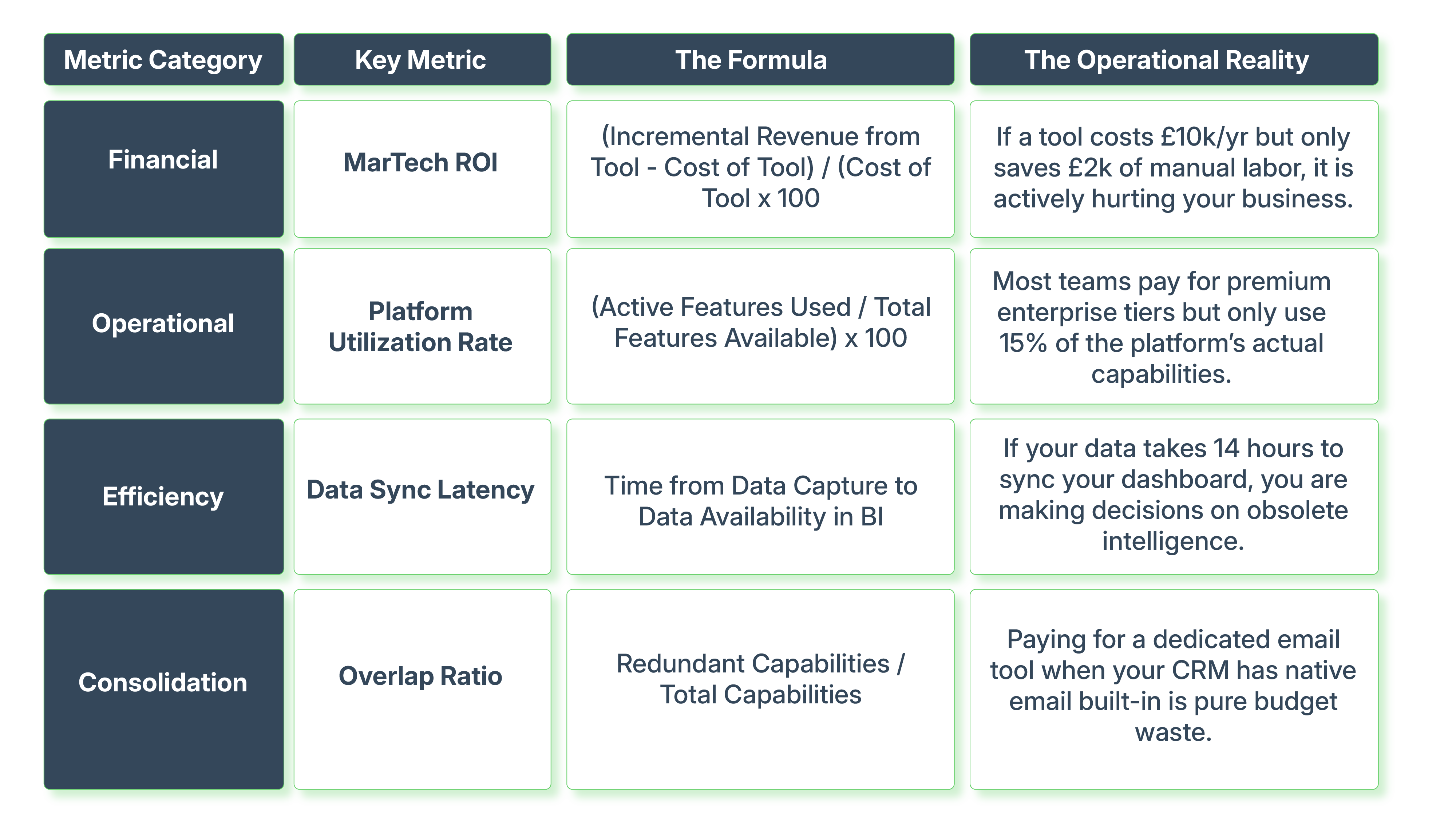
You cannot manage what you do not accurately measure. To build a high-performing ecosystem, you need to focus on core financial marketing KPIs that relate specifically to your technology investments.
Below is a breakdown of the critical metrics every modern Marketing Operations (RevOps) leader must track:
Advanced tool integration: BI, CDP, CRM, SEO & AI layers
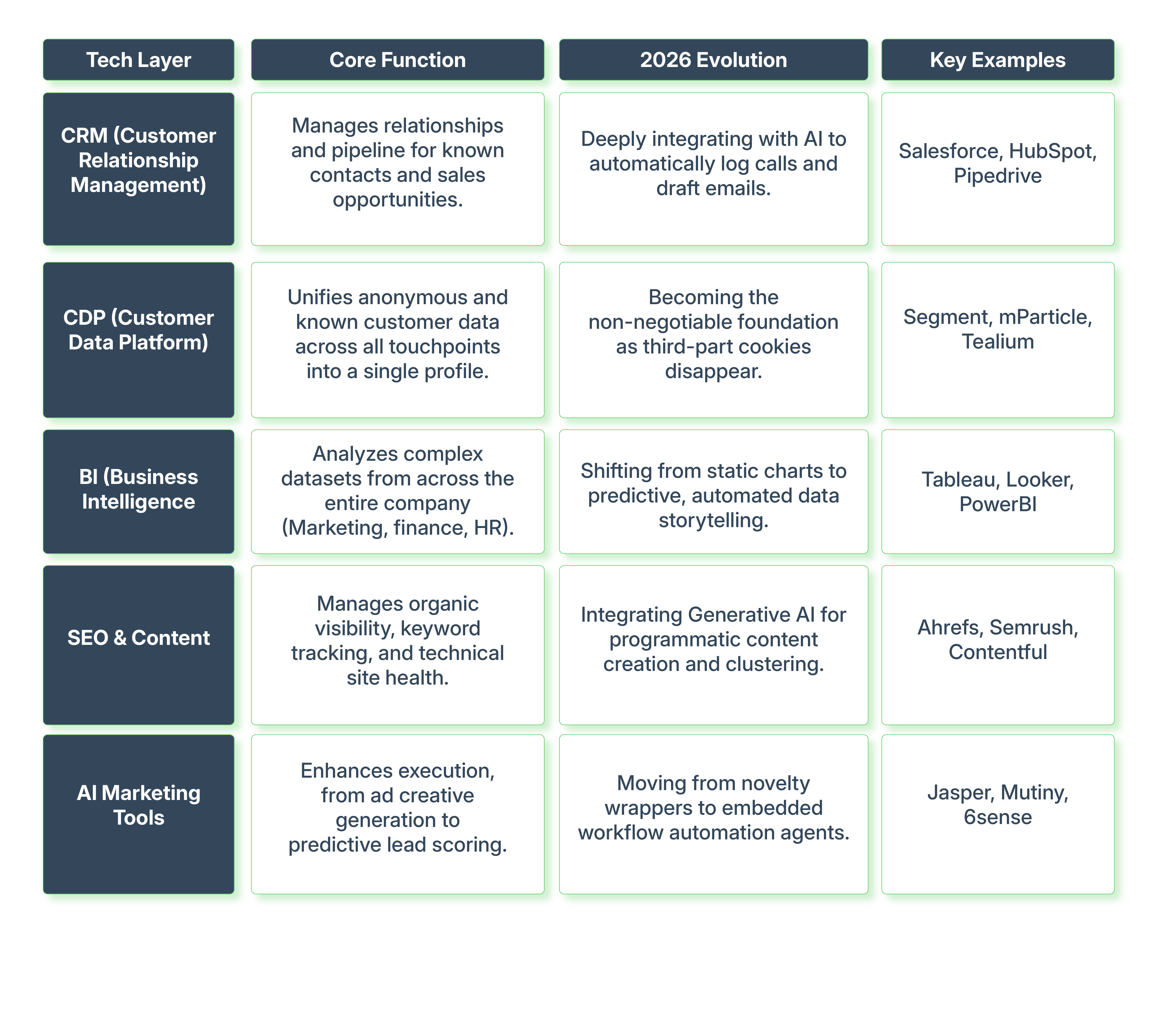
One of the hardest parts of marketing technology management is understanding where one tool ends and another begins. The software marketplace is incredibly crowded, and vendors deliberately blur the lines between their products.
Relying on a single "all-in-one" platform usually leads to mediocrity across all functions. Sophisticated teams build "best-in-breed" stacks connected via robust APIs.
Here is how the core layers interact in the real world:
 The framework: Data governance & taxonomy
Before you can build beautiful dashboards or run predictive AI models, you must master the operational groundwork. A successful MarTech framework is built on rigorous data governance.
Standardize your naming conventions: Your tech stack will break if your nomenclature is chaotic. Let's say your email manager builds a campaign called 2026_Q1_Webinar, but your social team tags their tracking links with utm_campaign=Q1-Web-26. Your BI layer will read this as two entirely different initiatives, splitting your ROI in half.
The fix: create a rigid, company-wide spreadsheet detailing exact naming conventions for sources, mediums, campaign names, and lead statuses. Enforce it ruthlessly across every tool in the stack.
Establish a single source of truth: Your Meta Ads dashboard will always enthusiastically claim it drove more conversions than Google Analytics says it did. Ad platforms want to look good.
Tip: You must definitively declare which system is the ultimate "source of truth." For most B2B companies, this is their CRM. If the revenue isn't recorded as closed-won in the CRM, it didn't happen, regardless of what the localized ad platform dashboard claims.
The Hurree insight pattern: Common MarTech mistakes
Even with the best tools, operational blind spots can completely derail your stack strategy.
Mistake: The "shiny object" syndrome
- Operational problem: A marketing director attends a tech conference, sees a flashy demo for a new AI generative video tool, and immediately signs a 12-month enterprise license without consulting the operations team.
- Big-picture consequence: You allocate thousands of pounds to a tool that doesn't integrate natively with your Data Asset Management (DAM) system or CRM. Adoption plummets, the data remains siloed, and the tool becomes expensive shelfware within three months.
- Why it’s overlooked: Humans are wired to seek quick fixes for deep systemic problems. It is infinitely easier to buy a new piece of software than to fix a broken internal process.
- The fix: Implement a strict procurement process. No new software is purchased unless it demonstrably solves a documented bottleneck and possesses a native API connection to your core database.
Mistake: Siloed tools leading to double counting
- Operational problem: The social team's standalone tool reports 50 conversions. The search team's platform reports 50 conversions. The CEO expects 100 new customers, but the CRM only shows 60.
- Big-picture consequence: Leadership loses complete faith in marketing reports, viewing the tech stack as a bloated expense rather than a revenue driver. Budgets are subsequently slashed.
- Why it’s overlooked: Disconnected ad platforms inherently take 100% credit for the same user who clicked a LinkedIn ad on Tuesday and a Google ad on Thursday.
- The fix: Rely on centralized CRM data and unified attribution models to de-duplicate conversions before reporting them to the board.
Strategic takeaways for marketing leaders
To turn this guide into action, follow these immediate operational steps:
- Audit your tech stack: Run a comprehensive audit of every piece of software your department pays for. Map out exactly what each tool does, what it costs, and who internally owns it. You will likely find at least 20% redundancy.
- Consolidate before you innovate: Do not buy an advanced AI predictive tool if your CRM is still filled with duplicate records and bad email addresses. Fix the foundation first.
- Build a single pane of glass: Stop forcing your leadership team to log into six different platforms. Invest in centralized marketing dashboards so your entire team is looking at the exact same, truthful numbers.
- Enforce taxonomy rules: Stop the data chaos at the source. Implement strict UTM, naming conventions, and data governance policies today.
Hurree: The intelligence layer for modern marketing
Everything we've covered sounds straightforward on paper. In reality, most marketing teams fail because their data lives in 15 disconnected systems. You cannot run advanced marketing strategy frameworks when your ad spend is stuck in Meta, your pipeline is trapped in Salesforce, and your financial data is walled off in Xero.
The most significant barrier to mastering your marketing tech stack isn't a lack of tools; it is a profound lack of clarity.
Your data is scattered across dozens of platforms, hidden in departmental silos, and trapped in static spreadsheets that are out of date the very moment you save them. You cannot make agile, predictive decisions when you are spending hours just trying to export and format CSV files.
Hurree is the unifying analytics intelligence layer that solves this.
By centralizing your scattered data sources into one environment, Hurree allows you to step out of the chaos and into control. We provide:
- Up-to-date visibility: Build unified dashboards that display your true, de-duplicated marketing ROI across every tool in your stack, instantly.
- Automated insights: Stop hunting for anomalies. Our AI Analyst constantly monitors your cross-platform data, proactively identifying KPI deviations and risk signals before they become board-level crises.
- Seamless collaboration: Create complete transparency across internal teams and agency clients with shared views that ensure everyone is looking at the same, unarguable source of truth.
- No-code connectivity: Connect your entire stack in minutes with our library of pre-built connectors for every major CRM, CDP, BI, and advertising tool on the market.
Don't wait for a bloated software budget to tell you your strategy isn't working. Take total control of your tech stack and turn integration into your greatest competitive advantage.
See Hurree in Action → Book Your Demo Today
FAQs: Marketing tech stack
What is the difference between MarTech and AdTech?
While often used interchangeably, MarTech (Marketing Technology) focuses on first-party data and managing direct campaigns (like CRMs, email marketing, and content management). AdTech (Advertising Technology) focuses on third-party data and programmatic ad purchasing (like Demand-Side Platforms and ad networks).
How do you audit an existing marketing tech stack?
Start by mapping data flows and identifying overlapping features. List every tool your team pays for, measure the actual utilization rates of current seats, and calculate the ROI of each individual platform against its subscription cost. If a tool doesn't actively increase revenue or drastically reduce manual hours, it should be cut.
What is the difference between a CRM and a CDP?
A CRM (Customer Relationship Management) system primarily manages interactions with known contacts and customers, mostly driven by sales data. A CDP (Customer Data Platform) aggregates both anonymous and known behavioral data from every digital touchpoint (website clicks, app usage, ad views) to create a comprehensive, unified customer profile.
How much should a company spend on marketing technology?
According to industry benchmarks, marketing technology typically accounts for roughly 25% to 30% of the total marketing budget. However, the focus should always be on MarTech ROI rather than arbitrary spending caps; a highly integrated tool that replaces three headcount tasks is worth a premium.
How do you integrate legacy systems into a modern MarTech stack?
Rather than forcing native integrations that don't exist, utilize APIs or middleware solutions (like Zapier or Tray.io). Alternatively, the most robust solution is to push raw data from the legacy system directly into a central data warehouse, allowing your BI tool or dashboarding layer to read it without disrupting existing operations.

![Try Riva Vision Free [White sq]](https://no-cache.hubspot.com/cta/default/2080894/601698e6-f9dc-4078-b29d-72a4f17991ff.png)
Share this

How To Be a Data-Driven Marketer: 8 Key Steps

What is a Marketing Dashboard? (With Examples)
.jpg)