It’s Monday morning, and you are sitting in the monthly leadership review. The CEO looks at your slide deck, which highlights a 30% increase in website traffic and a record number of social media engagements.
Then comes the question that can paralyze even the most well-prepared marketer: "That's great, but how much revenue did that actually generate for us?"
If you have to hesitate, guess, or promise to "pull a report and get back to them," your marketing department is operating on borrowed time. The most successful marketing teams in 2026 do not just launch creative campaigns; they operate as precision revenue engines. Every dollar spent is tracked, every customer touchpoint is measured, and every strategic pivot is backed by hard numbers.
In short
- Data-driven marketing is the strategy of using customer information, historical performance, and predictive analytics to optimize marketing messaging, channels, and budget allocation.
- The maturity model: Stop guessing. High-performing teams move from reactive, descriptive reporting to proactive, predictive marketing intelligence.
- The Hurree framework: You need an operational engine. We break down the four phases: Collection, Unification, Activation, and Measurement.
- The math matters: To be truly data-driven, your team must obsess over business metrics (CAC, LTV, Pipeline Velocity) rather than platform metrics (Likes, Impressions, Clicks).

What is data-driven marketing?
At its core, data-driven marketing is the methodology of making all strategic marketing decisions based on empirical data rather than intuition or past assumptions.
It involves capturing vast amounts of information, from how users navigate your website, to which emails they open, to how often they interact with your sales team, and analyzing that data to predict their future behavior.
A traditional, intuition-based marketer might say, "Let's run a LinkedIn campaign because our competitors are doing it, and B2B buyers are on LinkedIn."
A data-led marketing team says, "Historical CRM data shows that leads acquired via LinkedIn have a 40% higher Customer Lifetime Value than leads from Twitter, despite a higher initial acquisition cost. We will allocate $20,000 to LinkedIn this quarter to maximize long-term pipeline value."
It is the shift from hoping a campaign works to mathematically engineering its success.
Why data-driven marketing matters (the operational reality)
For in-house marketing teams, transitioning to a data-driven model dictates your credibility, your budget, and your team's survival.
For in-house marketing teams:
Marketing has historically struggled with a perception problem. Sales brings in the money; marketing spends it on "brand awareness." When budgets get tight, the department that cannot prove its financial contribution is the first to face cuts.
Implementing a data-driven marketing strategy fundamentally changes this dynamic. When you can walk into a board meeting and definitively prove that a specific webinar series generated $150,000 in closed-won revenue at a Customer Acquisition Cost of $500, you are no longer a cost center. You become an investment.
Furthermore, data gives your team the agility to fail fast and pivot. Instead of waiting until the end of a six-month campaign to realize the messaging didn't resonate, real-time data allows you to spot a dropping conversion rate on day three, tweak the copy, and save the campaign.
The data-driven marketing maturity model
Transitioning your team doesn't happen overnight. Let's look at the four stages of evolution. Most companies are stuck in the first two stages, drowning in raw data but starving for actionable intelligence.
Descriptive marketing: "The rearview mirror"
This is the baseline standard. The team relies entirely on historical data to describe what happened last month.
- The reality: You run a campaign, wait 30 days, and download a CSV from Google Analytics to see how many people visited the landing page.
- The consequence: You are always reacting to the past. By the time you realize a campaign failed, the budget has already been spent.
Diagnostic marketing: "The autopsy"
At this level, analysts begin comparing variables to understand the root cause of success or failure.
- The reality: You notice that landing page traffic was high, but conversions were low. You dig into user behavior data and realize a broken form field on mobile devices caused a 90% drop-off.
- The consequence: You can fix problems after they occur, but you are still losing initial momentum while you diagnose the issue.
Predictive marketing: "The forecast"
This is where teams become truly data-driven. Using historical trends and machine learning, you forecast future outcomes before launching.
- The reality: Before allocating your Q3 budget, your analytics platform predicts that increasing spend on generic search terms will result in a 20% increase in Customer Acquisition Cost due to seasonal competition.
- The consequence: You avoid the trap. You proactively shift that budget into high-intent retargeting and email nurture campaigns, protecting your profit margins.
Prescriptive marketing: "The autopilot"
The highest form of maturity. Prescriptive systems not only predict the future but automatically recommend or execute the optimal action.
- The reality: Your ad platform detects a spike in engagement for a specific ad creative. Without human intervention, the system automatically pulls budget from underperforming ads and funnels it into the winning creative.
The Hurree framework: The data-driven marketing engine
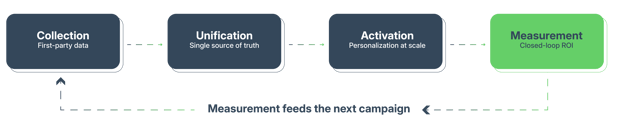
Most teams fail at data-driven marketing because they focus entirely on the analysis and ignore the infrastructure. To build a sustainable, scalable system, you must implement the Data-driven marketing engine:
- Phase 1: Secure collection (first-party data). Relying on third-party cookies is a dead strategy. You must build systems (gated content, newsletters, account sign-ups) to collect first-party data directly from your audience.
- Phase 2: Unification (the single source of truth). Data is useless if it lives in silos. You must pipe your website analytics, email performance, and ad data into a centralized CRM or Customer Data Platform.
- Phase 3: Activation (personalization at scale). Using the unified data to actually do marketing. This means triggering dynamic email content based on what a user browsed on your pricing page yesterday.
- Phase 4: Measurement (closed-loop reporting). Tracking the user from that initial ad click all the way through to a closed-won deal in the CRM, proving the exact ROI of the activation phase.
The mathematics of data-driven marketing: Essential KPIs
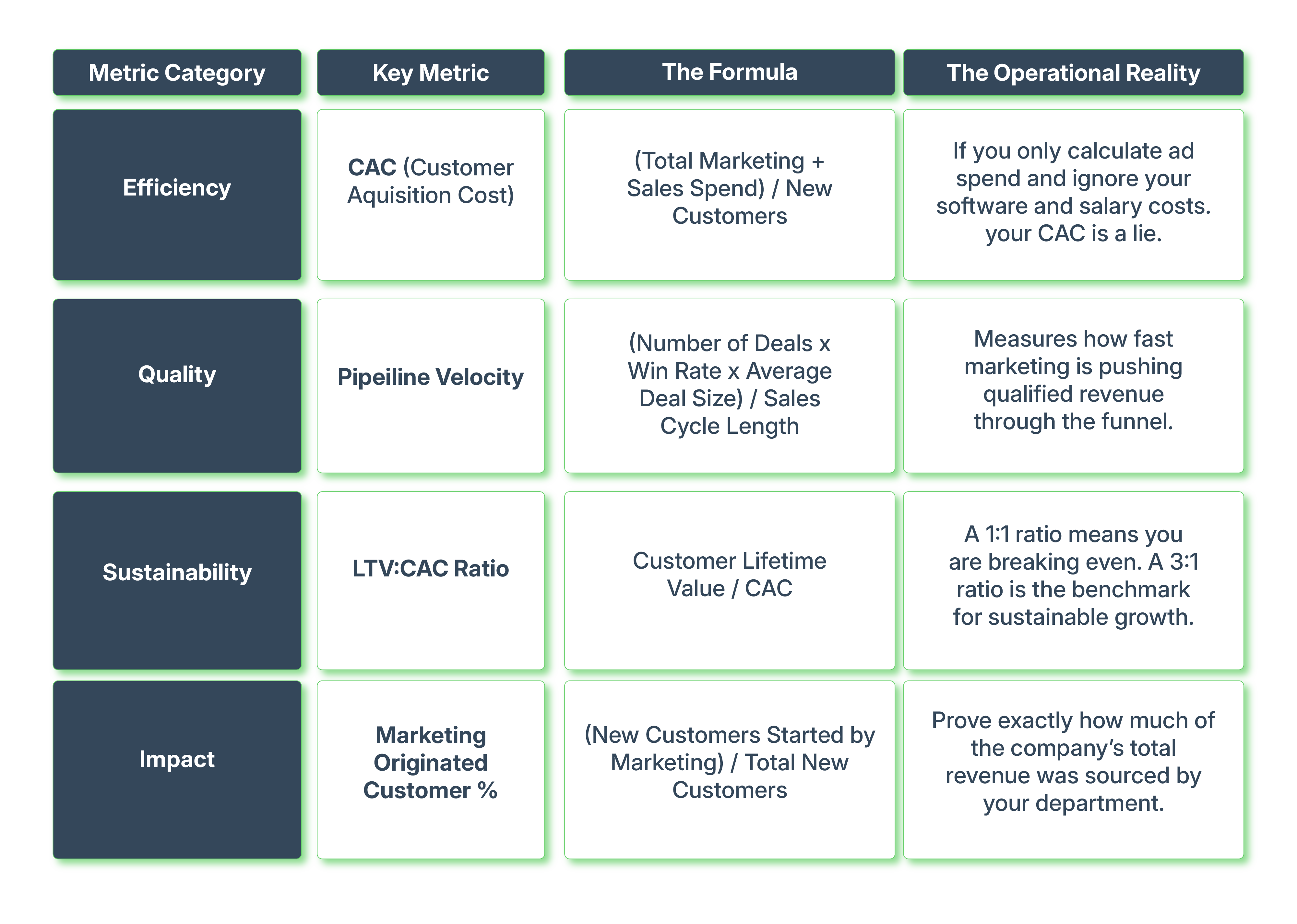
You cannot be data-driven if you are obsessing over the wrong data. To build a high-performing ecosystem, you must transition your focus from platform metrics (clicks, likes, open rates) to business metrics.
Below is a breakdown of the critical metrics every modern marketing team must track:
Advanced tactics: Moving beyond basic dashboards
Once you have the foundation in place, true marketing data analytics requires sophisticated tactics to maintain a competitive edge.
Implement marketing mix modeling (MMM)
As privacy regulations tighten and ad blockers become the norm, tracking individual users across the internet is becoming nearly impossible. Marketing Mix Modeling uses macro-statistical analysis to look at aggregate data. It analyzes how historical spikes in your overall ad spend correlate with spikes in total sales, factoring in external variables like seasonality, allowing you to measure channel effectiveness without relying on invasive tracking cookies.
Embrace incrementality testing
If you run a branded search ad and someone clicks it and buys, did the ad cause the sale, or were they going to buy anyway? Incrementality testing finds the truth. You turn off your ads in one geographic region (the holdout group) and keep them running in another. If sales drop in the holdout group, you have definitively proven that your marketing is incrementally driving revenue.
The Hurree insight pattern: Common data mistakes
Even with the right metrics, operational blind spots can completely derail your data strategy.
Mistake: Paralysis by analysis
- Operational problem: Your team has built a stunning dashboard tracking 45 different metrics across 12 channels. Every Monday, the team spends two hours reviewing the dashboard.
- Big-picture consequence: The team is so overwhelmed by the sheer volume of data that no one actually makes a decision. You are tracking everything, but changing nothing.
- Why it’s overlooked: We equate the volume of data with the quality of our strategy.
- The fix: Identify your "One Metric That Matters" (OMTM) for the quarter (e.g., MQL-to-SQL Conversion Rate). If a piece of data doesn't help you move that specific metric, ignore it.
Mistake: Confusing "data-driven" with "data-blinded"
- Operational problem: An A/B test shows that a bright red, aggressively flashing CTA button increases clicks by 15%. The team rolls it out across the entire website.
- Big-picture consequence: While clicks increase, your brand perception plummets. High-value enterprise clients find the site spammy and leave, resulting in a drop in actual revenue.
- Why it’s overlooked: The team followed the data blindly without applying qualitative, human context.
- The fix: Use data to inform your decisions, but never let it override common sense, brand guidelines, or qualitative customer feedback.
Strategic takeaways for marketing leaders
To transition your team to a data-driven model, follow these immediate operational steps:
- Audit your KPIs: Look at your last monthly marketing report. If more than half of the metrics are top-of-funnel engagement stats (traffic, likes, impressions), you need to rebuild your reporting around pipeline and revenue.
- Fix your tracking: A data-driven strategy fails if the data is corrupt. Standardize your UTM parameters and ensure your CRM is established as the single source of truth.
- Upskill your team: Data literacy is no longer just for analysts. Every copywriter, designer, and campaign manager must understand how their specific work impacts the core financial metrics.
- Build a single pane of glass: Invest in centralized marketing dashboards so your entire team is looking at the exact same, truthful numbers.
Hurree: The intelligence layer for modern marketing
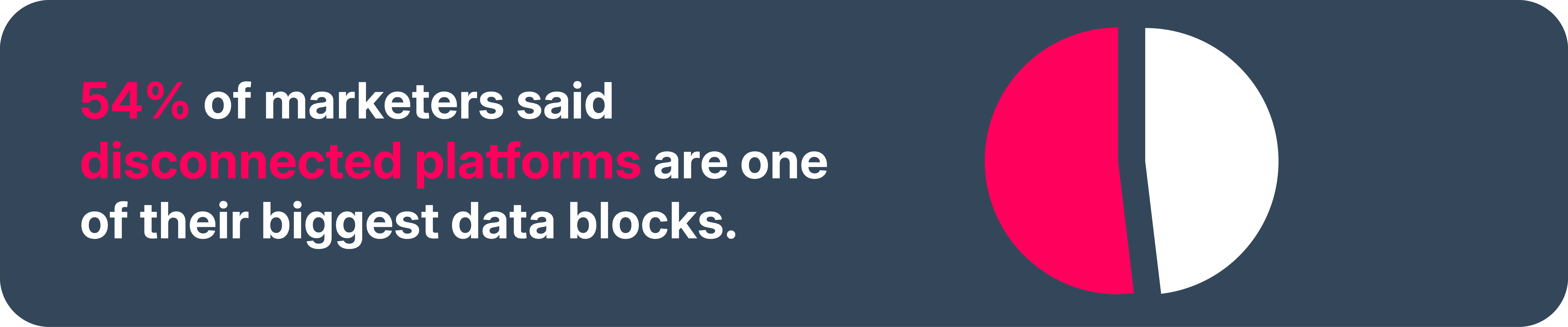
Everything we've covered sounds straightforward on paper. In reality, most marketing teams fail to become data-driven because their data lives in 15 disconnected systems. You cannot run advanced marketing intelligence models when your ad spend is stuck in Meta, your pipeline is trapped in Salesforce, and your financial data is walled off in Xero.
Source: MarketingProfs
The most significant barrier to mastering data-driven marketing isn't a lack of data; it is a profound lack of clarity.
Your data is scattered across dozens of platforms, hidden in departmental silos, and trapped in static spreadsheets that are out of date the very moment you save them. You cannot make agile, predictive decisions when you are spending hours just trying to export and format CSV files.
Hurree is the unifying analytics intelligence layer that solves this.
By centralizing your scattered data sources into one environment, Hurree allows you to step out of the chaos and into control. We provide:
- Up-to-date visibility: Build unified dashboards that display your true, de-duplicated marketing ROI across every tool in your stack, instantly.
- Automated insights: Stop hunting for anomalies. Our AI Analyst constantly monitors your cross-platform data, proactively identifying KPI deviations and risk signals before they become board-level crises.
- Seamless collaboration: Create complete transparency across your entire department with shared views that ensure everyone is looking at the same, unarguable source of truth.
- No-code connectivity: Connect your entire stack in minutes with our library of pre-built connectors for every major CRM, CDP, BI, and advertising tool on the market.
Don't wait for a board meeting to tell you your strategy isn't working. Take total control of your data and turn visibility into your greatest competitive advantage.
See Hurree in Action → Book Your Demo Today
FAQs: Data-driven marketing
What is the difference between data-driven and data-informed marketing?
Data-driven marketing relies almost entirely on empirical data and algorithms to make decisions (e.g., an algorithm automatically adjusting ad bids). Data-informed marketing uses data as one of several inputs, alongside human intuition, qualitative feedback, and brand guidelines, to make a final strategic choice.
How do you collect data without relying on third-party cookies?
As privacy regulations tighten, teams must pivot to zero-party data (data a customer intentionally shares, like a quiz or preference center) and first-party data (behavioral data tracked on your own website or app). This requires offering genuine value, like an exclusive industry report or a useful tool, in exchange for an email address and tracking consent.
Why do data-driven marketing strategies fail?
The most common point of failure is data silos. If the marketing team is looking at Google Analytics data, and the sales team is looking at CRM data, the numbers will never match. Without a centralized integration layer establishing a single source of truth, teams spend more time arguing about the data than acting on it.
What are the best tools for data-driven marketing?
While the exact stack varies, a modern framework requires a Customer Data Platform (CDP) or robust CRM to unify user profiles, a marketing automation platform for execution, and a centralized Business Intelligence (BI) or dashboarding layer to visualize the cross-channel ROI.
How do you measure the ROI of brand awareness campaigns?
While harder to track than direct-response ads, you can measure brand awareness using "Share of Search" (the volume of organic searches for your brand name compared to competitors), direct traffic volume, and marketing mix modeling to see if brand spend correlates with an overall lift in organic conversion rates.
![Try Riva Vision Free [green]](https://no-cache.hubspot.com/cta/default/2080894/ce315bc1-5200-4b4a-8263-92d08a3d607e.png)

Share this

What is Data Integrity?

[Video] 6 Benefits of Data Integration in Marketing