As marketers, we should never underestimate the power of planning. For most of us, that means creating a water-tight marketing strategy, informed by analysis and data, and one that is based on objectives, a target market, and proven tactics.
We all use different blueprints depending on our industry, our target audience and our products and services. But there’s one timeless model that any marketer can use regardless of their field of work and that is the marketing mix.
What is the marketing mix?
Traditionally, the marketing mix is a framework for your marketing strategy made up of four key elements: Product, Place, Price, and Promotion.
This later evolved into the extended marketing mix, or 7Ps, which contains the original four elements plus three more that are critical, especially for services and modern experiences: Physical Evidence, People, and Process.
It’s important to note that while the marketing mix can influence your strategy and provide a greater understanding of the wider market (and your own business), it doesn’t work in isolation. The marketing mix is a tactical framework that works best when it’s used regularly or semi‑regularly as a structure for planning, executing, evaluating and re-evaluating your marketing activities in line with changing customer behaviour and market conditions.
Who created the 7ps of the marketing mix model?
The concept of the marketing mix was originally developed by Neil H. Borden, who built on James Culliton’s description of business executives as “mixers of ingredients” – those ingredients being different marketing features and practices.
The idea was later refined by Jerome McCarthy, who specifically identified four key components: Product, Place, Price and Promotion. McCarthy wrote about the 4Ps in the 1960s in his book “Basic Marketing: A Managerial Approach”.
As marketing and business matured, especially with the rise of services, the original 4Ps became too narrow. In 1981, B.H. Booms and M.J. Bitner expanded the framework, identifying three additional elements they saw as key: Physical Evidence, People, and Process. Together, these form the extended marketing mix we know today as the 7Ps.
It makes sense that these three were added because:
- People are at the heart of every business.
- Process shapes how consistently and efficiently you deliver value.
- Physical Evidence helps customers trust that your brand is real and credible.
Without these, the model struggles to capture how modern service and experience‑driven businesses actually operate.
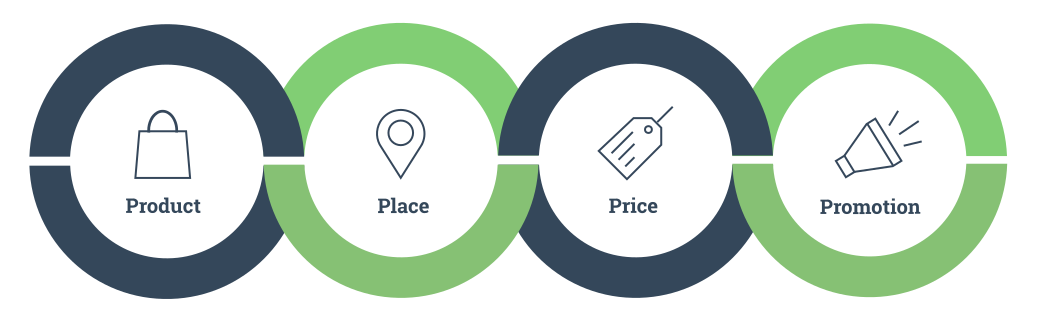
The 4Ps vs the 7Ps
The original 4Ps of the marketing mix covered the fundamental factors of business and marketing at the time – when physical products and traditional retail dominated.
However, as services, experiences, and digital‑first businesses grew, it became clear that the original mix didn’t fully capture the realities of customer experience. People, Process, and Physical Evidence all directly influence how customers perceive and interact with brands, especially in service‑heavy sectors like hospitality, SaaS, healthcare, or financial services.
That’s why the shift to 7Ps matters: it broadens your view from just “what we sell, where, how much, and how we promote it” to how we deliver the whole experience, who delivers it, and how customers know we’re trustworthy.
What are the 7Ps of the marketing mix?
Now that you know what the 7Ps of the marketing mix are and their origins, let’s dive a little deeper into each.
1. Product
Product refers to what is being sold - a physical product, service, or experience.
No matter how you position yourself as a brand, your product or service is always going to be at the centre of your strategy and will influence every aspect of the marketing mix. When you think of your product, consider factors such as:
- Quality
- Specific features and benefits
- Packaging and presentation
- The problem that it will solve for your customers
- How it compares to alternatives
Product in this case, then, is about crafting something that meets the needs and desires of your target audience. This means understanding their preferences, pain points, and aspirations. By meticulously aligning your product with customer expectations, you create a solid starting point for your marketing endeavours. Over 30,000 consumer products are launched yearly. Out of these 30,000 new products, 95% of them fail woefully without having any significant impact on the market.
In 2026, “Product” goes beyond the physical: it includes UX, integrations, onboarding, and support. For digital products and SaaS tools, your interface, documentation, and customer success resources are all part of the product experience.
2. Place
Place is about where and how you distribute your product so the right customers can access it easily.
Choosing the right distribution channels significantly impacts your product’s reach, visibility, and sales. Effective placement ensures your product is available when and where your target audience wants it.
Today, Place doesn’t just mean physical locations. It includes:
- Websites and eCommerce platforms
- Online marketplaces
- Social commerce (e.g. Instagram Shop, TikTok Shop)
- App stores
- Catalogues and trade shows
- Brick‑and‑mortar stores and pop‑ups
With 48% of consumers choosing ecommerce for its convenience, understanding how they shop is critical. This is where AI transforms guesswork into strategy. AI tools can analyze vast datasets of customer purchase behavior, search trends, and even real-time inventory levels to recommend the most profitable distribution channels and optimize stock allocation across them.
This helps you:
- Identify your most profitable channels
- Spot regions or segments with unmet demand
- Decide whether you need your own store, a marketplace presence, or both
If your audience is global and primarily online, relying only on a single high‑street store simply won’t work. Place is about being present where your customers naturally are, not where you wish they were.

Source: GWP Group
3. Price
Price is the amount customers pay for your product or service, and it’s one of the most powerful levers in your entire mix.
A misstep in pricing doesn’t just hurt your ROI, it can also alienate your customer base or undermine your brand positioning. With over 80% of consumers now comparing prices, it’s vital that price reflects:
- Perceived customer value
- Market conditions and competition
- Real‑time demand signals
- Your cost structure and profit goals
There are many pricing strategies:
- Price skimming: Begin with a high price, gradually lowering it over time.
- Competition-based pricing: Set prices above or below competitors' rates.
- Economy pricing: Target budget-conscious buyers with lower prices.
- Premium pricing: Attach a high price, emphasizing product quality.
- Value-based pricing: Set prices based on perceived value, not just cost.
- Cost-plus pricing: Add a fixed margin on top of production cost.
In recent years, dynamic, AI‑driven pricing has become mainstream in sectors like travel, ride‑sharing, and eCommerce. For example,the price of an Uber ride can double on a busy, rainy Saturday night compared to a quiet weekday afternoon, not by accident, but based on an AI algorithm balancing real‑time supply and demand.
Whatever strategy you choose, ensure it:
- Matches your brand positioning
- Resonates with your target audience
- Keeps the business sustainably profitable
Regularly review pricing in light of inflation, competitor moves, and customer feedback.

4. Promotion
Promotion is how you communicate your value to your audience, the activities you use to build awareness, interest, desire, and action.
Promotion includes:
- Advertising (online and offline)
- PR and media outreach
- Content marketing (blogs, guides, whitepapers)
- Social media and influencer marketing
- Events and webinars
- In‑store experiences
- Email and marketing automation
Effective promotion is built on strong answers to questions like:
- Where is your audience most active – online, in stores, on specific social platforms?
- Is your business seasonal? How does seasonality impact campaigns?
- What is your brand personality, and how should it shape your messaging and creative?
- How do your competitors promote themselves, and what gaps or opportunities exist? A SWOT analysis helps here.
- Can you use AI to personalize creative assets and messaging at scale?
- Are there new or emerging channels your audience has adopted (e.g. TikTok, niche communities)?
- What does your customer review and social sentiment data tell you to highlight next?
Promotional tactics fall broadly into:
- Traditional: print, TV/radio, direct mail, billboards, word of mouth.
- Digital: email, social media, SEO, content marketing, paid search, social ads, mobile, and programmatic.
Digital channels tend to generate more interactions and richer data, but the goal is a unified omnichannel presence rather than an either/or.
Modern tools, including generative AI, can help you:
- Produce on‑brand copy and visuals at scale
- Test multiple creative variations quickly
- Identify which messages resonate with specific segments
However, AI must be guided by a clear strategy and strong data. When combined with the right segmentation and performance metrics (e.g. using a Hurree dashboard), it helps ensure the right message reaches the right person at the right time, and doesn’t devolve into generic content that audiences ignore.
5. Physical Evidence
Physical Evidence is all the tangible and visible elements that prove your brand is real, trustworthy, and consistent.
It includes:
- Your website and app
- Visual identity and branding (logo, colours, typography)
- Social media presence
- Your physical premises or signage
- Product packaging
- Printed materials (brochures, receipts, manuals)
- Post‑purchase communications (thank you emails, onboarding sequences)
- The look and feel of your physical environment (store decor, office, reception)
Customers look for cues that you’re viable, reliable, and legitimate before and after they buy from you. Physical Evidence helps them answer questions like:
- “Can I trust this brand with my money and data?”
- “Does this feel professional and consistent?”
- “Do other people use and recommend this product?”
To build strong Physical Evidence:
- Ensure your website is fast, modern, and easy to navigate
- Maintain consistent branding across all channels and materials
- Showcase reviews, case studies, and testimonials
- Provide clear documentation and support resources
- Make your packaging and unboxing experience reflect your brand promise
In digital businesses (especially SaaS), Physical Evidence is often:
- UI/UX quality
- Help centre and documentation
- Onboarding flows
- Public roadmaps
- Customer stories and third‑party reviews
These elements reassure customers that you’re established, dependable, and here to stay.
6. People
People refers to everyone involved in delivering your product or service and shaping customer experience:
- Sales teams
- Customer support and success teams
- Product managers and developers
- Marketers and content creators
- Front‑line staff in physical locations
- Leadership and founders
- Even chatbots and automated systems, which represent your brand voice
It’s critical to the success of your brand – and your customer satisfaction – that everyone who represents the company is:
- Polite and professional
- Knowledgeable about your offering
- Equipped to solve customer problems
- Aligned with your brand values
To make that happen, you need to invest in:
- Training and onboarding
- Clear documentation and playbooks
- A supportive, healthy work environment
- Internal alignment on brand promise and customer experience standards
The stakes are high. Around 50% of consumers will switch to a competitor after a single bad experience, and 80% will switch after multiple poor experiences. Excellent customer service is non‑negotiable in today’s customer‑centric market.
Digital strategist Dave Chaffey notes that people buy from people because of the human connection we all crave. When marketers create a strategy that’s highly tailored and personalised, they can be as influential as the best salesperson, both online and offline.
Having the right people, supported by the right tools, is key to both short‑ and long‑term success.

Source: ZenDesk
7. Process
Process encompasses everything that happens around each interaction and transaction – the systems and workflows behind the scenes that shape customer experience from first touch to renewal or repeat purchase.
Process includes:
- How quickly you respond to enquiries
- The steps between booking a demo and actually speaking to sales
- How easy it is to complete a purchase or signup
- Onboarding and training flows
- How you follow up post‑purchase
- How you collect and act on feedback
- How you generate and showcase positive reviews
Even if you have a best‑in‑class product, you can be let down by poor processes.
Questions to ask:
- How long does it take us to respond to new leads or support tickets?
- How many steps are in our checkout or signup flow? Where do people drop off?
- What happens in the first 7–30 days after someone becomes a customer?
- How are we encouraging satisfied customers to leave reviews or refer others?
- Which tools (AI, CRM, email platforms, KPI dashboards) can help us automate and improve key steps?
Regularly assessing, adjusting, and improving your processes helps you deliver a seamless, consistent experience and operate at optimal efficiency.
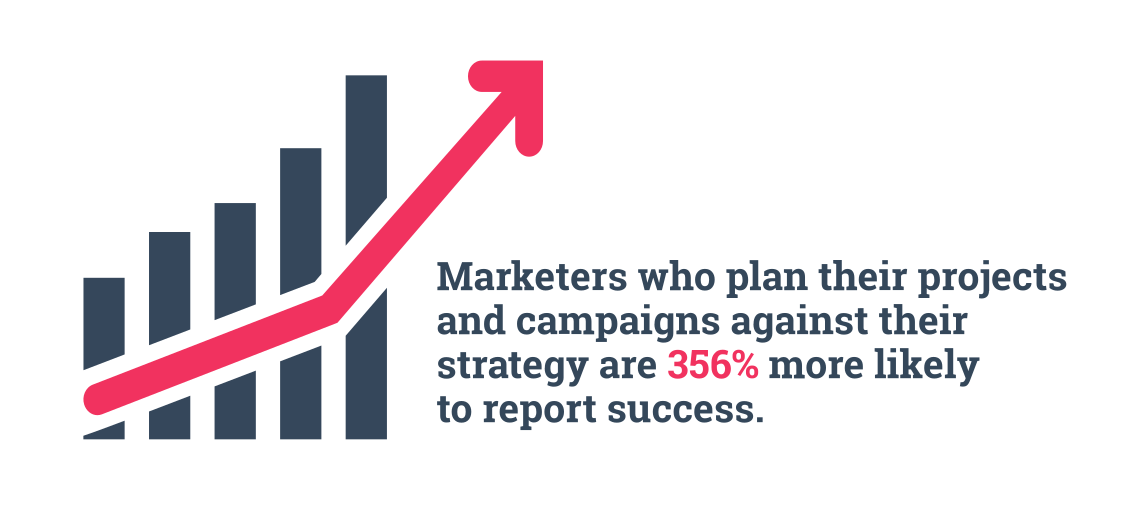
Source: Oracle
Regularly assessing, adjusting and adapting your processes will help to structure your business efforts so that you can function at optimal efficiency.
Applying the 7Ps in today’s marketing landscape
The core ideas behind the 7Ps haven’t changed, but the context around them absolutely has. In marketing today:
- Product includes UX, integrations, and digital experiences.
- Place includes eCommerce, marketplaces, apps, and social platforms.
- Price can be dynamic and AI‑driven.
- Promotion spans content, social, paid, and automation.
- Physical Evidence is often digital e.g websites, reviews, and UI.
- People may include remote teams and digital touchpoints.
- Process is increasingly automated and data‑driven
How the 7Ps work for B2B and SaaS businesses
For B2B SaaS or SaaS products, you might think of the 7Ps like this:
- Product: features, roadmap, integrations, security, and onboarding.
- Place: your website, partner marketplaces, app stores, and ecosystems (e.g. HubSpot, Salesforce).
- Price: subscription tiers, freemium vs paid, usage‑based pricing.
- Promotion: webinars, content, paid search, product‑led growth loops, partner marketing.
- Physical Evidence: UI, documentation, case studies, G2/Capterra reviews.
- People: product experts, customer success, solution engineers, and community managers.
- Process: trial flows, PQL (product‑qualified lead) scoring, upgrade triggers, renewal and expansion journeys.
Adapting the 7Ps for omnichannel retail and eCommerce
For eCommerce or omnichannel retail:
- Product: assortment, bundles, quality, returns and warranty.
- Place: online store, marketplaces, physical shops, click‑and‑collect.
- Price: seasonal pricing, discount strategies, loyalty pricing.
- Promotion: email campaigns, social ads, influencer collaborations, in‑store promotions.
- Physical Evidence: packaging, store layout, product photography, user‑generated content.
- People: store staff, support agents, personal shoppers, chat support.
- Process: checkout flow, shipping and returns, stocking and fulfilment, post‑purchase follow‑up.
Using a tool like Hurree to track performance across these touchpoints helps you see which combinations of Ps drive the best results, and where to improve.
The 7Ps in service‑based businesses
The extended 7Ps model is particularly powerful in service‑based industries, where experiences matter as much as (or more than) tangible products. Think of sectors like hospitality, healthcare, consulting, agencies, education, or financial services.
People, process, and physical evidence in service experiences
In services, the three additional Ps become especially important:
- People: front‑of‑house staff, consultants, support teams, practitioners.
- Process: booking, intake, delivery, follow‑up, feedback collection.
- Physical Evidence: offices, venues, websites, uniforms, documentation, and signage.
For example, in a hotel:
- People: reception staff, housekeeping, concierge, restaurant staff.
- Process: check‑in, room service, billing, check‑out.
- Physical Evidence: lobby design, room cleanliness, signage, website, reviews.
In a B2B agency:
- People: strategists, account managers, analysts.
- Process: discovery, proposals, onboarding, reporting, retrospectives.
- Physical Evidence: case studies, pitch decks, website, client portal.
The 7Ps help you design not just what you offer, but how every interaction feels from the customer’s perspective.
Why are the 7Ps of the marketing mix important?
The 7Ps of the marketing mix are important because they give marketers a complete, structured view of what drives success. Instead of focusing on a single tactic, they encourage you to:
- Align product development with customer needs
- Price strategically, not reactively
- Choose distribution channels that match customer behaviour
- Promote in ways that reinforce positioning
- Use People, Process, and Physical Evidence to build trust and loyalty
By looking at each element together, you can build strategies that are:
- Balanced (not overly reliant on one lever)
- Measurable (each P has clear KPIs)
- Adaptable (you can tweak individual elements without losing coherence)
To make this framework truly effective, it must be supported by accurate, up‑to‑date data. Data shows:
- How each P performs in practice
- What’s working and what’s underperforming
- Where to adjust for better results
Hurree helps put this into action. By bringing all your marketing data into one central dashboard, Hurree makes it easy to monitor KPIs across every element of the mix. You can see:
- How campaigns influence demand (Product & Promotion)
- How pricing changes affect conversions (Price)
- How channel performance shapes reach (Place)
- How process improvements impact satisfaction and retention (Process, People)
Hurree’s built‑in AI assistant, Riva, takes this a step further by analysing performance and providing intelligent recommendations based on your results. Instead of manually interpreting dashboards, marketers can lean on Riva’s insights to understand:
- What’s driving performance
- Where risks are emerging
- Which opportunities deserve focus next
The 7Ps provide the structure, data provides insight, and Hurree connects the two, giving marketers the clarity they need to make confident, data‑driven decisions.

Criticisms of the 7Ps model and how to use it effectively
No framework is perfect, and the 7Ps are no exception. Common criticisms include:
- It can feel product‑centric, even with the three added Ps.
- It doesn’t explicitly cover areas like brand, customer relationships, or long‑term retention.
- It can be applied too rigidly, as a checklist rather than a flexible tool.
- In digital contexts, some argue it doesn’t fully capture data, privacy, or platform dynamics.
However, the 7Ps remain valuable when you:
- Treat them as a lens, not a complete map
- Combine them with modern approaches like customer journey mapping, personas, JTBD (Jobs to be done), and data analytics
- Regularly revisit each P as your market, product, and customers evolve
In practice, the most effective teams use the 7Ps alongside a robust analytics stack (like Hurree) and qualitative insights to form a rounded, modern strategy.
How can I use the 7Ps?
The 7Ps marketing mix is more than just a theory; it’s a versatile toolkit you can use to create impactful, effective strategies.
Here’s how to apply it step by step:
- Start with solid research
Understand your target audience in detail. Conduct market research to uncover their preferences, behaviours, goals, and pain points. This insight informs every decision you make across the 7Ps. - Tailor your product offering
Design your product or service around those needs and expectations. Differentiate yourself from competitors by adding value and solving specific problems your audience cares about. - Pricing precision
Develop a pricing strategy aligned with customer expectations and perceived value. Factor in costs, competitors, demand, and brand positioning. Test and refine over time. - Strategic placement
Choose distribution channels that make it easy for your audience to find and buy from you, whether that’s physical stores, eCommerce, marketplaces, or a mix of both. - Powerful promotions
Craft promotional campaigns that resonate. Use the right blend of advertising, content, social, email, and PR to reach and engage your audience where they are. - Prioritise people
Invest in employee training and alignment. Ensure your team understands your brand and is equipped to deliver great customer experience at every touchpoint. - Streamline processes
Optimize your processes to make the customer journey smooth and consistent. From lead generation to post‑purchase support, efficiency and clarity are key.
Throughout, use performance data and dashboards to monitor what’s working and iterate.
Conclusion
The 7Ps of the marketing mix provide a clear, practical framework for building strategies that genuinely connect with customers. By understanding your audience’s preferences and challenges, you can make smarter decisions across each element of the mix – and adapt as markets evolve.
With Hurree, you can bring all your marketing and performance data together to:
- Monitor how each P is performing
- Uncover insights and opportunities
- Apply the 7Ps more effectively and confidently
The result is a strategy that stays relevant, data‑driven, and built for lasting success in a rapidly changing digital landscape.


Share this

What Are The Major Components of a Marketing Strategy?

Experiential Marketing: 4 Es to Future-proof Your Strategy