

Most marketing teams track their own numbers obsessively and watch their competitors casually. They know their CAC to three decimal places and have "a rough sense" of what the three competitors they lose deals to are doing in-market. That gap, between what you know about yourself and what you know about the people you're actually competing with, is where competitive marketing intelligence lives.
The teams that close that gap tend to make better strategic decisions. The teams that don't tend to make expensive ones.
So let's walk through what it actually is, what it changes, and how to build it without turning it into a full-time job.
In short
- Competitive marketing intelligence is the ongoing practice of tracking what competitors are doing in-market and using that intelligence to inform your own marketing decisions. Not generic market research. Not scrolling LinkedIn.
- It overlaps with market intelligence but is narrower. Market intelligence covers the whole market, customers, trends, regulation, broader forces. Competitive intelligence focuses specifically on competitors.
- The business impact is highest in budget conversations, positioning decisions, and launch planning, exactly the moments where "we think" gets tested against "we know."
- Most teams underinvest in it because the ROI is harder to point at than campaign metrics, even though the decisions it informs are bigger ones.
What competitive marketing intelligence actually is
Competitive marketing intelligence is the discipline of systematically gathering, analysing, and using information about your competitors' marketing to make better strategic decisions. The operative word is systematically. One-off competitor audits aren't intelligence; they're research projects. Intelligence implies an ongoing function with a cadence, sources, outputs, and a stakeholder who acts on it.
What's typically inside it:
- Competitor positioning and messaging shifts
- Ad spend patterns and channel mix (through transparency libraries and SEO visibility tools)
- SEO moves, including new pages, keyword expansion, and SERP visibility changes
- Pricing changes and packaging updates
- Product launches, roadmap signals, and feature releases
- Hiring signals that hint at strategic direction
- Review and reputation signals from G2, Capterra, Trustpilot, and similar platforms
- Content strategy shifts, including publication cadence, topic clusters, and distribution
How it differs from adjacent terms
A quick disambiguation, because these terms get used interchangeably and shouldn't be:
|
Term |
What it covers |
|---|---|
|
Competitive intelligence |
Specifically about competitors. Their moves, their positioning, their performance. |
|
Market intelligence |
Broader. Includes competitors but also customers, trends, regulation, and macro forces. |
|
Market research |
Project-based. Specific questions, specific answers, usually commissioned. |
|
Customer intelligence |
About your customers and prospects. Buying patterns, pain points, satisfaction. |
|
Competitive benchmarking |
A specific exercise within competitive intelligence. Measuring your performance against theirs on defined metrics. |
Competitive marketing intelligence is the sub-discipline of competitive intelligence that focuses specifically on marketing activity. If you want a fuller view of how it fits into broader marketing strategy, that's the strategic layer that competitive intelligence feeds into.
The business impact: Where competitive intelligence actually earns its budget
This is the section most generic guides skip, and it's the one that matters. Competitive intelligence doesn't justify itself through "we know more about our competitors now." It justifies itself by changing specific decisions in specific moments. Here's where it earns the budget.
Budget conversations. When the CFO asks why you're asking for a 30% increase in paid search, "because our main competitor just doubled their spend on our top three keywords and we're losing share of voice" is a materially better answer than "we think we need more budget." Competitive intelligence turns budget asks from intuition into evidence.
Positioning and messaging decisions. When three competitors shift their messaging in the same direction over a quarter, that's a signal about where the market is going. Teams without competitive intelligence tend to notice six months later and spend another quarter catching up. Teams with it notice early and decide whether to follow, counter-position, or stay the course.
Launch planning. Launching a product or feature into a market without knowing what competitors are launching in the same window is how you end up buried in the news cycle. Competitive intelligence tells you when the field is quiet and when it's crowded.
Deal defence. When sales loses a deal, and the reason is "they went with Competitor X," competitive intelligence tells you whether that's a pattern (a positioning problem) or an outlier (a sales execution problem). Those are different fixes.
Talent and acquisition signals. When a competitor hires three enterprise AEs in a month, they're probably moving upmarket. When they hire a VP of Partnerships, they're probably building a channel. These are early signals about strategic shifts that get expensive to catch up to later.
The common thread: competitive intelligence is highest-value at decision moments, not as background reading. Teams that treat it as a quarterly report nobody reads capture almost none of this value. Teams that build it into the actual decision-making rhythm capture most of it.
Competitive intelligence vs market intelligence vs market research: Which one solves which problem
These terms get used interchangeably, which creates expensive confusion when teams buy the wrong thing or commission the wrong research. Here's the honest breakdown:
|
Competitive intelligence |
Market intelligence |
Market research |
|
|---|---|---|---|
|
Focus |
Competitors specifically |
The whole market, including competitors |
Specific questions |
|
Cadence |
Ongoing |
Ongoing |
Project-based |
|
Primary use |
Tactical and strategic decisions about your own marketing |
Strategic planning, market entry, portfolio decisions |
Answering specific unknowns |
|
Typical output |
Battle cards, win/loss analysis, positioning briefs, alerts |
Market sizing, trend reports, macro briefings |
Research reports, survey findings |
|
Owned by |
Product marketing, revenue operations, or a dedicated CI function |
Strategy function, often sitting with the C-suite |
Marketing or research function, often commissioned externally |
|
Cost pattern |
Mostly tools and headcount, modest to moderate |
Mix of tools, data subscriptions, and analyst time |
Project cost, often large and lumpy |
You need competitive intelligence if the question is "what are our competitors doing and what should we do about it." You need market intelligence if the question is "where is this market going." You need market research if the question is specific and bounded, like "do our prospects care about feature X?"
Most teams need all three at different times. Confusing them is how you commission a six-figure market research project to answer a question competitive intelligence could have surfaced in a week.
The sources that can actually matter in 2027
Not every signal is worth tracking. Here's the honest stack, grouped by what each source tells you.
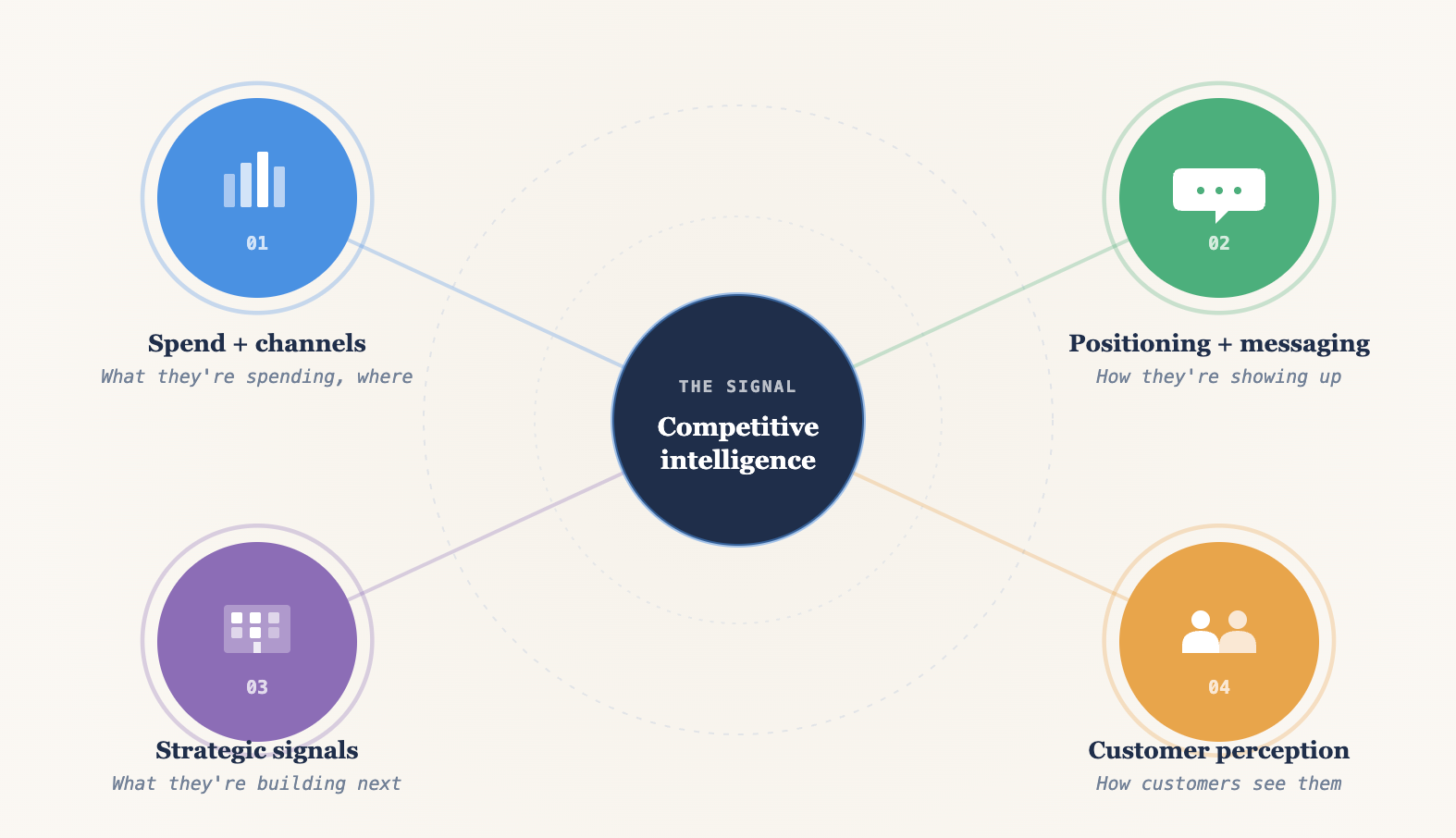
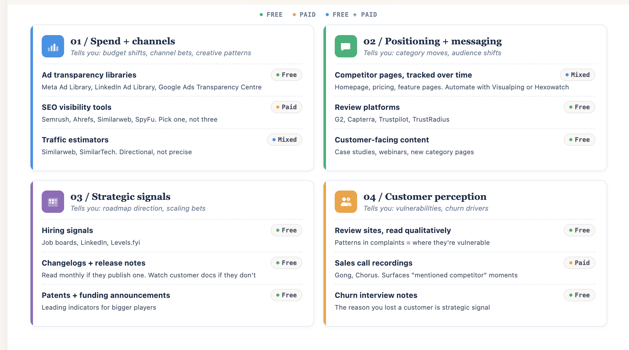
What competitors are spending and where
- Ad transparency libraries. Meta Ad Library, LinkedIn Ad Library, Google Ads Transparency Centre. Free, legitimate, surprisingly underused. They show you creative, cadence, and often reach estimates.
- SEO visibility tools. Semrush, Ahrefs, Similarweb, SpyFu. Pick one. They give you organic and paid keyword overlap, new content, and ranking shifts.
- Website traffic estimators. Similarweb and SimilarTech show rough traffic patterns. Directional, not precise, but useful for spotting shifts.
How competitors are positioning
- Their homepage, pricing page, and feature pages. Monthly screenshots catch messaging drift. Tools like Visualping or Hexowatch automate this.
- Review platforms. G2, Capterra, Trustpilot, and TrustRadius. New reviews, response patterns, and category movement are all signals.
- Their customer-facing content. Case studies, webinars, and new category pages tell you who they're targeting and how they want to be seen.
What competitors are building
- Hiring signals. Job boards, LinkedIn, and sites like Levels. fyi. A sudden burst of enterprise sales hires or a new engineering team is a strategic signal.
- Product changelogs and release notes. If they publish one, read it monthly. If they don't, their customer-facing docs often shift just before major releases.
- Patent filings and funding announcements. For bigger players, these are leading indicators.
How customers see them
- Review sites, as above, but read qualitatively. Patterns in complaints tell you where they're vulnerable.
- Sales call recordings. Your own sales team is a goldmine. Tools like Gong and Chorus surface "mentioned competitor" moments at scale.
- Churn interview notes. When you lose a customer to a competitor, the reason matters.
The specific competitor analysis tools worth considering vary by budget and sophistication, and the truth is that most teams need two or three, not twelve. Start with ad transparency libraries (free), an SEO visibility tool (one, not three), and a sales call intelligence tool if you have sales calls worth analysing. Everything else is additive.
The in-house vs agency question: Who should actually run this
This is the part most generic guides skip, and it's one of the most useful questions to answer honestly.
In-house competitive intelligence works well when you have a clear, limited competitive set (five to ten competitors), someone who can own it as part of their role (usually product marketing or revenue operations), and a leadership team that will act on the output. The advantage is proximity. The person running it sits in the same room as the people making decisions, which means intelligence turns into action faster.
Agency-delivered competitive intelligence works well when the competitive set is larger or more volatile, when there's no internal headcount to own it, or when you want a third-party perspective to avoid the "we only see what we want to see" problem that in-house CI often develops. The disadvantage is distance: agencies produce reports and client teams interpret them, and sometimes the interpretation layer loses the point.
For agencies offering competitive intelligence as a service, the business case is strong. Clients increasingly want strategic input alongside tactical execution, and competitive intelligence is one of the highest-leverage inputs an agency can offer. It also tends to be a billable deliverable that charges materially higher margins than campaign work, because the clarity it produces is strategic rather than operational.
Here's the honest comparison:
|
In-house CI |
Agency-delivered CI |
|
|---|---|---|
|
Best for |
Focused competitive set, clear ownership, action-oriented leadership |
Larger competitive set, no internal headcount, outside perspective needed |
|
Cost pattern |
Headcount + tools |
Retainer or project |
|
Speed from intelligence to action |
Fast (sits in the same room) |
Slower (needs interpretation layer) |
|
Depth of context |
Deep on the business, lighter on broader market |
Broader market view, lighter on internal context |
|
Risk |
Blind spots and confirmation bias |
Report fatigue, intelligence that nobody acts on |
The best setups often combine the two: a lightweight in-house function that handles the daily and weekly signals, and an agency or specialist that handles the quarterly deep-dives.
When competitive intelligence misleads you
This section is the one almost no guide includes, and it's probably the most important one. Competitive intelligence has specific failure modes worth knowing about before you build the function.
You end up copying someone else's bad strategy. Just because a competitor is doing something doesn't mean it's working for them. The visible signal (ad spend, content volume, messaging shifts) doesn't tell you whether it's generating pipeline. Teams that reactively copy competitors often end up chasing moves that are actively failing in-market.
You stop paying attention to your customers. Competitive intelligence is seductive because it feels like strategy. Spending too much time watching competitors can quietly displace the harder work of understanding your own customers, which is almost always the better input into positioning decisions.
You confuse motion with momentum. Competitors who publish a lot, launch frequently, or run many ads look busy. Busy and successful are different things. The quietest competitor in your market might be the most dangerous one.
You overfit to short-term signals. A competitor doubling their paid spend for a quarter might be running an experiment, not committing to a channel. Over-indexing on short windows produces reactive strategy. Watch patterns over quarters, not weeks.
You miss what's not there. Competitive intelligence is good at telling you what competitors are doing. It's less good at telling you what they're deliberately not doing, which is often the more strategic signal. The absence of a move is a signal too.
The honest guardrail: competitive intelligence should inform maybe a third of your strategic decisions. Customer intelligence and your own performance data should drive the rest. Teams that invert that ratio tend to end up with reactive, me-too strategies.
What the cadence actually looks like
Not every signal belongs on every cadence. Here's a working rhythm for most B2B marketing teams.
|
Cadence |
What you review |
Who owns it |
|---|---|---|
|
Weekly |
Ad transparency library sweeps, SEO visibility shifts, new content from top 3 competitors |
Marketing ops or product marketing |
|
Monthly |
Positioning changes, pricing updates, review platform patterns, hiring signals |
Product marketing + marketing leader |
|
Quarterly |
Full competitive briefing, win/loss patterns, strategic shifts |
Marketing leader + CRO or sales leader |
|
Annually |
Full competitive landscape review, portfolio assessment |
C-suite + strategy function |
Weekly and monthly reviews should produce short written outputs: three to five lines on what shifted, what it suggests, what action it might warrant. Quarterly reviews produce the substantial briefing that actually drives planning conversations.
The failure mode here is building a quarterly report that nobody uses. The fix is attaching the output to decisions people are already making, like budget reviews, campaign planning, or launch retros. Intelligence that lives in a shared drive doesn't change behaviour. Intelligence that shows up in the meeting where decisions get made does.
A unified marketing dashboard that includes competitive signals alongside your own performance metrics is one of the easiest ways to make this habit stick, because it puts the competitor view in the same place leadership is already looking.
The honest limits of what you can know
A quick honest note. Competitive intelligence has real limits that generic guides tend to gloss over.
- You can see what they're doing, not what's working for them. Pipeline, revenue, retention, and CAC are invisible from outside.
- Everything you see is a lagging indicator. Published pages, launched campaigns, and completed hires reflect decisions made weeks or months ago.
- The signal-to-noise ratio is challenging. Most of what competitors publicly do is not strategically meaningful. Learning to filter is harder than learning to collect.
- Private companies tell you much less than public ones. VC-funded competitors are opaque in ways public ones aren't.
None of this is a reason not to invest. It's a reason to be honest about what you're buying and to spend accordingly.
Hurree: The intelligence layer for competitive and marketing data combined
Competitive intelligence is most valuable when it sits alongside your own performance data in one view. The budget conversation isn't "here's what our competitors are doing" or "here's our pipeline." It's both, in the same picture.
Hurree is the unifying analytics intelligence layer that makes this possible.
By centralising your performance data from across platforms, Hurree gives marketing leaders a single environment where competitive signals can sit alongside pipeline, CAC, channel efficiency, and the metrics that actually drive decisions. We provide:
- Up-to-date visibility: Unified dashboards that bring your own performance data together, so the competitive view has somewhere to live.
- Automated insights: Our AI Analyst monitors cross-platform data continuously, surfacing shifts that matter before they become quarterly surprises.
- Seamless collaboration: Shared transparency across marketing, sales, and strategy functions, so competitive intelligence feeds into decisions rather than sitting in a report nobody opens.
If you're building a competitive intelligence function and want it to actually change decisions rather than produce reports, that's exactly what Hurree is built to support.
FAQs
Is competitive marketing intelligence the same as competitive analysis?
Not quite. Competitive analysis is usually a one-off exercise: you sit down, review a competitive set, produce an output, and move on. Competitive marketing intelligence is the ongoing function that keeps that analysis current and feeds it into decisions. Think of competitive analysis as a snapshot and competitive intelligence as the live feed. Most teams do analysis occasionally and call it intelligence, which is why the discipline often fails to compound.
How much does a competitive intelligence function cost to run?
Lightweight setups (one person spending 20% of their time, free tools and one paid SEO tool) run under $5,000 a year. Mid-weight setups (a dedicated role plus three to four paid tools) land in the $100,000 to $150,000 range all-in. Enterprise setups with a dedicated CI team, premium data subscriptions, and external analyst support can run into the millions. The right investment depends more on how much your decisions are worth than on your company size. Teams making big strategic bets with little intelligence are overspending on risk, not saving on headcount.
Which teams in a company actually use competitive intelligence?
More than most people realise. Product marketing uses it for positioning and launch planning. Sales uses it for deal defence and battle cards. Product uses it for roadmap decisions. Executive leadership uses it for strategic planning and board narratives. Marketing uses it for campaign and channel decisions. The failure mode is a CI function that only serves one of those teams, which is how CI gets labelled "nice to have." The highest-leverage setups serve three or four stakeholders with tailored outputs.
Can I run competitive intelligence without any paid tools?
Yes, more than most people assume. Ad transparency libraries are free. Google Alerts for competitor mentions costs nothing. LinkedIn, press releases, and company blogs give you most of the strategic signal you need. The two places where paid tools genuinely pay for themselves are SEO visibility (one paid tool matters here; free alternatives don't go deep enough) and sales call intelligence (Gong or Chorus, if you have sales calls worth analysing). Everything else can start free and upgrade later.
How do agencies price competitive intelligence as a service?
Three common models. First, bundled, included as a value-add in a broader retainer, typically with limited depth. Second, project-based, a specific competitive deep-dive priced per project, often $5,000 to $25,000 depending on scope. Third, dedicated service: an ongoing monthly retainer specifically for competitive intelligence, typically $3,000 to $15,000 a month depending on competitive set size and output cadence. The third model tends to command the strongest margins because the output directly informs client strategy, not just execution.
What's the most common mistake teams make with competitive intelligence?
Collecting without acting. Teams build dashboards, subscribe to tools, and produce reports, then don't attach any of it to actual decisions. The output lives in a shared drive, and nobody references it in the meetings where it would matter. The fix is working backwards from decisions. What are the three or four decisions a quarter that competitive intelligence should inform? Build the output to serve those meetings specifically. Intelligence that doesn't change behaviour is overhead.
How does competitive intelligence connect to broader marketing strategy?
Competitive intelligence is an input into strategy, not a substitute for it. A strong marketing strategy is anchored in customer insight, business goals, and your own strengths. Competitive intelligence helps you understand the terrain you're operating in and the moves others are making, but the strategy itself should be about where you're going and why. Teams that use competitive intelligence as the primary input into strategy tend to end up with reactive, me-too positioning. Teams that use it as context for their own strategic conviction tend to end up with sharper, more defensible positioning.
What's the fastest way to start if we have nothing in place today?
Pick three competitors. Open their homepage, pricing page, and the Meta Ad Library listing for each. Sign up for Google Alerts on their brand names. Schedule 30 minutes every Friday to review what you see. That's it. You've started. Add tools and sophistication once you know what questions you want to answer, not before. The teams that build elaborate CI functions before knowing what they're trying to learn tend to produce reports nobody reads. The teams that start simple and expand based on what proves useful tend to build something that actually works.
From watching competitors to using them well
The teams that get competitive intelligence right don't necessarily spend more on it than the teams that get it wrong. They spend differently. They attach it to specific decisions, they filter aggressively, and they treat it as an input into strategy rather than a substitute for one. The output is clearer thinking, better-defended decisions, and fewer expensive surprises.
If you're starting from scratch, start small. Three competitors, free tools, 30 minutes a week. Expand based on what proves useful. The sophistication can come later. The habit has to come first.