Open any 2027 trends deck, and you will find the same forecast: AI everywhere, running more of marketing every quarter. It is the loudest prediction in the industry right now.
But it’s not necessarily the most common one.
We caught the same tension early. When we asked more than 200 marketers, agency owners, and founders a single open question about the year ahead for our comprehensive predictions report, a large group predicted the opposite of the boom. Nearly a third, 32%, expect a bust or a human backlash, outnumbering the 25% who expect AI to dominate. They are not rejecting the technology. They expect the market to start paying a premium for the things AI cannot fake: trust, authenticity, and real human connection, as AI-generated content fills every feed.
This is the AI backlash. Here is what it actually looks like in the data, and why it matters even if you think the optimists are right.
In this post
- How big the AI backlash really is in the 2027 data, and why it is easy to miss
- What marketers mean by the "authenticity premium," in their own words
- The return-to-offline prediction hiding inside the same theme
- Why this matters even if you expect AI to win
- The difference between authenticity you can prove and authenticity you only claim

The backlash is bigger than the hype cycle admits
When speaking with industry experts, AI dominated the conversation. It appeared in 47% of substantive predictions in the report, which is why it is easy to assume the optimists have already won the argument. They haven’t. Past that 47%, agreement falls apart, and the second-largest single theme in the study is more pessimistic–or realistic–about the future of AI in marketing.
It is the human counter-current. At 14.8% of substantive predictions, roughly one in seven, the authenticity backlash is the biggest theme after AI dominance itself, which sits at 24.9%. It describes a reaction against AI: a rising premium on trust, personality, and real connection.
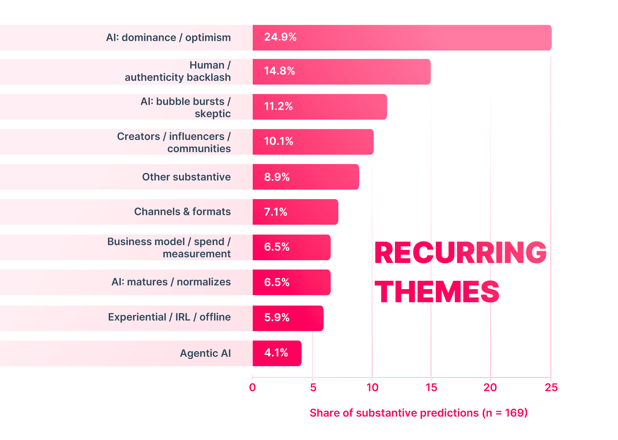
The skeptic vocabulary recurs alongside it. In the AI camp, 11.2% of predictions expect the bubble to burst, and the words "bubble," "hype," and "slop" show up again and again. Group the authenticity backlash together with the marketers expecting a return to offline and in-person marketing, and this human and offline counter-current reaches 20.7% of considered predictions, more than a fifth.
That is not a fringe. Set the 29.0% of predictions in the combined AI-optimist camp against the 20.7% counter-current, and the gap is far narrower than the trend decks suggest. It is the loudest quiet trend in marketing right now.
What marketers actually mean by "authenticity"
Authenticity gets used as a soft word. In the responses behind that 14.8% it is anything but. As AI content becomes cheap and everywhere, the scarce thing becomes a brand that feels real: consistent, transparent, and clear about what it stands for. That is the exact case respondents made, in their own words.
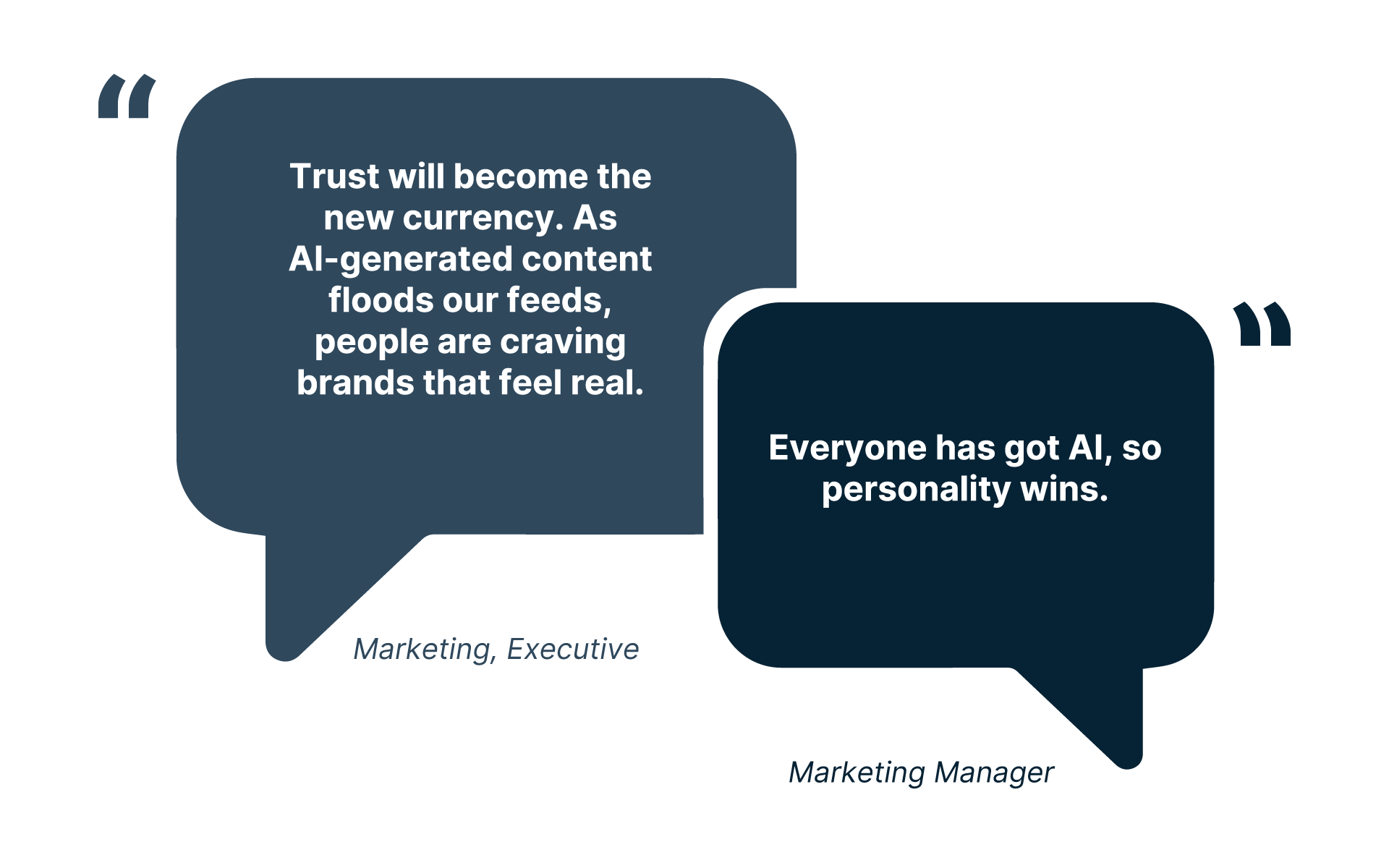
The logic is simple. When every competitor can generate a thousand passable posts a week, the passable post stops being an advantage. What cuts through is the thing that is hard to automate.
The other half of the backlash: A return to the real world
Sitting next to the authenticity theme is a related prediction: a return to physical and in-person marketing. Out-of-home, experiential activity, and face-to-face events all recur. Some marketers frame it in stark terms.
"Dead Internet theory will come through, and we will return to physical advertising and experiences."
Marketing Assistant
This is the offline half of that 20.7% counter-current. Taken together, authenticity and offline form one coherent counter-position to the AI-dominance camp. If AI floods the feed, attention moves to the places and formats where a human still has to show up.
Why this matters even if you think AI wins
You do not have to believe the backlash to plan for it. The practical shift is quieter than the prediction, and most trend pieces miss it entirely.
Authenticity is moving from something brands claim to something they have to prove. If trust is going to be the advantage, then the signals that build it need to be tracked like any other performance metric, not asserted in a brand deck and hoped for. That is the part the loud forecasts skip. It is easy to say "trust will matter." It is much harder to show, quarter over quarter, that the trust you are building is actually converting.
The report identifies the specific trust signals the backlash camp expects audiences to reward, so you can measure them rather than assume them. It also breaks down which roles and sectors are betting on this shift, because it is not spread evenly across the industry, and the pattern is less obvious than you would guess.
The backlash is already starting to land
This is not a forecast waiting to be tested. The ground is already shifting. Some of the largest AI labs have started talking openly about pacing development rather than sprinting, and a growing number of companies that cut roles to automate have quietly hired people back after the tools fell short. The correction the optimists said would never come is already turning up in the headlines. The backlash our respondents predicted for 2027 has a head start.
See the full picture
The trend decks tell you authenticity will matter. They do not tell you how to prove it is working, or who actually believes it is coming.
Our recent report has both. It maps the full three-way split, names the trust signals worth tracking, and shows exactly which roles and sectors are backing the backlash. It is built on first-party research: hundreds of responses gathered at MAD//Fest 2026.
Frequently asked questions
Is the AI backlash in marketing real, or just wishful thinking?
Real enough to be the second-largest single theme in our recent report: 14.8% of substantive predictions, roughly one in seven, from a study of more than 200 marketers. Widen it to include the return-to-offline predictions, and the human counter-current reaches 20.7%. It is not universal, though. It is concentrated in particular roles and sectors, and the full report shows where.
What is "AI slop"?
It is the term marketers use for the flood of low-effort, mass-generated AI content now filling feeds and inboxes. The concern in the research is not just that it is low quality, but that it makes anything genuinely human stand out more.
Does the backlash mean AI is overhyped?
That is a separate argument. A distinct group of skeptics, 11.2% of predictions, does expect the hype to correct. The authenticity backlash is a different point: it is about rising human demand for real connection, not about the technology failing.
Will AI replace marketers?
The data points the other way. As AI makes content abundant, the research suggests the scarce and valuable skills become the human ones: personality, judgment, and the ability to earn trust. Those get harder to replace, not easier.
How do you actually measure authenticity?
You treat it like any other metric and track the signals that build it over time, rather than claiming it once and moving on. The report sets out the specific signals to watch. In practice it comes down to seeing, across every channel, whether the trust you are building is translating into results.
Where does this data come from?
A first-party survey of hundreds of marketers, agency owners, and founders at MAD//Fest 2026.
Share this
Top Marketing Trends 2024: Future Insights and Predictions

4 Marketing Trends Incoming in 2022