Your reports say Meta is winning.
Last-click ROAS is high. Cost per purchase is below target. Leadership loves the slide.
But your CRM tells a different story.
The high-value customers arrived via organic search. Many “Meta conversions” had four prior touches from email, LinkedIn, and partner content. The channel getting all the credit isn’t the one doing all the work.
That’s what broken attribution does: it quietly corrupts your decisions.
Budgets shift to the wrong channels. Great campaigns get killed. Under-credited tactics get starved. You’re left defending numbers you don’t fully trust.
Marketing attribution is supposed to clarify performance. In reality, the wrong attribution models (and the way teams use them) often make things worse.
Let’s unpack the seven most common attribution models, where they go wrong, and how to fix your approach before it skews your strategy.
Why marketers need to treat attribution as a risk, not just a report
If you’re spending real money on paid media, content, or lifecycle campaigns, attribution isn’t a “nice to have.”
It directly affects:
- Budget allocation: Which channels get scaled, cut, or tested
- Campaign priorities: Which tactics are celebrated or killed
- Stakeholder trust: Whether leadership believes your reports
- Career trajectory: Your track record on using budget effectively
When attribution is off:
- You over-invest in channels that over-report conversions (often last-touch winners like branded search).
- You under-invest in channels that shape demand upstream (content, community, upper-funnel media).
- You fight with sales and finance over what “really drove” the numbers.
The risk isn’t just wasted spend. It’s strategic misalignment.
Attribution models are opinionated lenses on the same reality. If you don’t understand their biases and limitations, your “data-driven decisions” are just dressed-up guesses.
Marketing attribution 101: What it is and where it breaks
Before the models, a quick primer.
What is marketing attribution?
Marketing attribution is the practice of assigning credit for a conversion (lead, signup, sale, renewal) to the marketing touchpoints that influenced it.
Those touchpoints could be:
- Ad clicks (search, social, display)
- Organic visits (SEO, direct, referrals)
- Emails, SMS, push notifications
- Webinars, events, partner content
- In-app or product-led nudges
An attribution model is the rule set that decides how much credit each touchpoint gets.
Why attribution is so hard now
Modern journeys:
- Span multiple devices (mobile → desktop → tablet).
- Cross multiple walled gardens (Meta, Google, TikTok, LinkedIn).
- Include offline and dark social (word-of-mouth, Slack communities).
No model sees everything. Each is a simplification.
Your job isn’t to find the “perfect” attribution model. It’s to:
- Understand what each model assumes
- Match the model to your goals and data reality
- Combine model results with business judgment
Now, let’s walk through the seven most common attribution models you’ll encounter and the errors that quietly skew their results.
The 7 most common marketing attribution models
We’ll cover:
- Last-click attribution
- First-click attribution
- Linear attribution
- Time-decay attribution
- Position-based (U-shaped / W-shaped) attribution
- Data-driven (algorithmic) attribution
- Single-touch custom rules (e.g., “lead source” dominance)
For each: the operational problem it solves, the strategic consequences, why it’s misused, and how to use it properly.
1. Last-click attribution
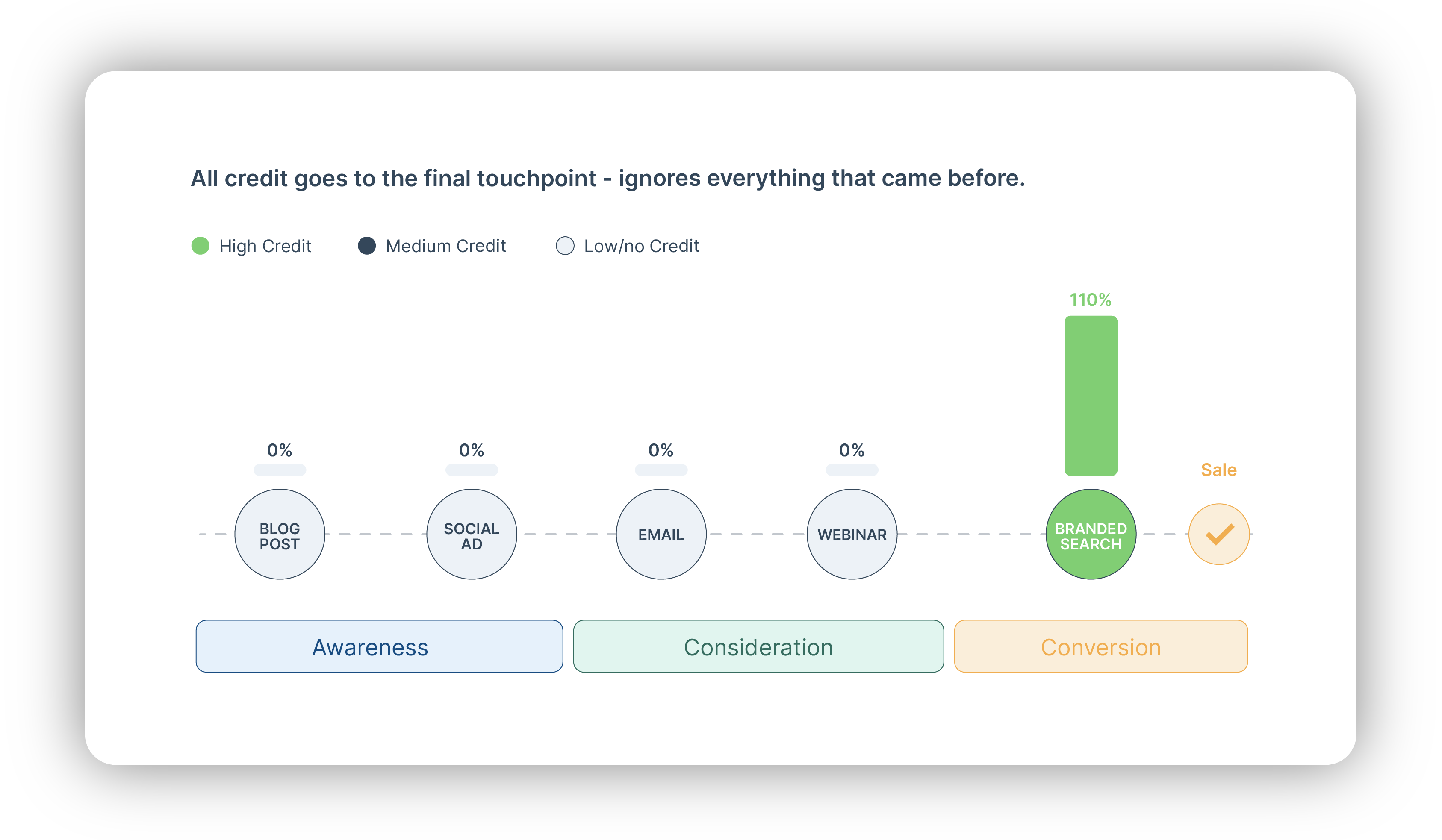
What it is: 100% of conversion credit goes to the last tracked touchpoint before conversion (e.g., branded search click, remarketing ad, direct visit).
Where you see it: Platform defaults (e.g., historically in Google Analytics Universal), simple spreadsheets, many CRM “lead source” fields.
The real-world problem it solves
You need a quick, simple view of which touchpoints close the deal.
- Easy to explain: “The last click we can see gets the credit.”
- Easy to implement: no complex modeling or stitching required.
Big-picture impact (hidden bias)
- Over-credits bottom-of-funnel channels (retargeting, branded search, direct).
- Under-credits awareness and mid-funnel programs (content, top-of-funnel paid, social).
- Incentivizes teams to chase easy clicks at the end of the journey, not build demand.
Why it’s overused
- It’s the default in many tools.
- Stakeholders like “simple answers.”
- It often makes performance look better, especially for lower-funnel campaigns.
Best practice fix
Use last-click only for:
- Understanding which channels are best at closing already-warm prospects.
- Operational reporting when you can’t access multi-touch data yet.
And never:
- As the single source of truth for budget decisions.
- For evaluating brand or awareness investments.
Combine with: at least one multi-touch view (e.g., position-based or data-driven) for strategic planning.
2. First-click attribution
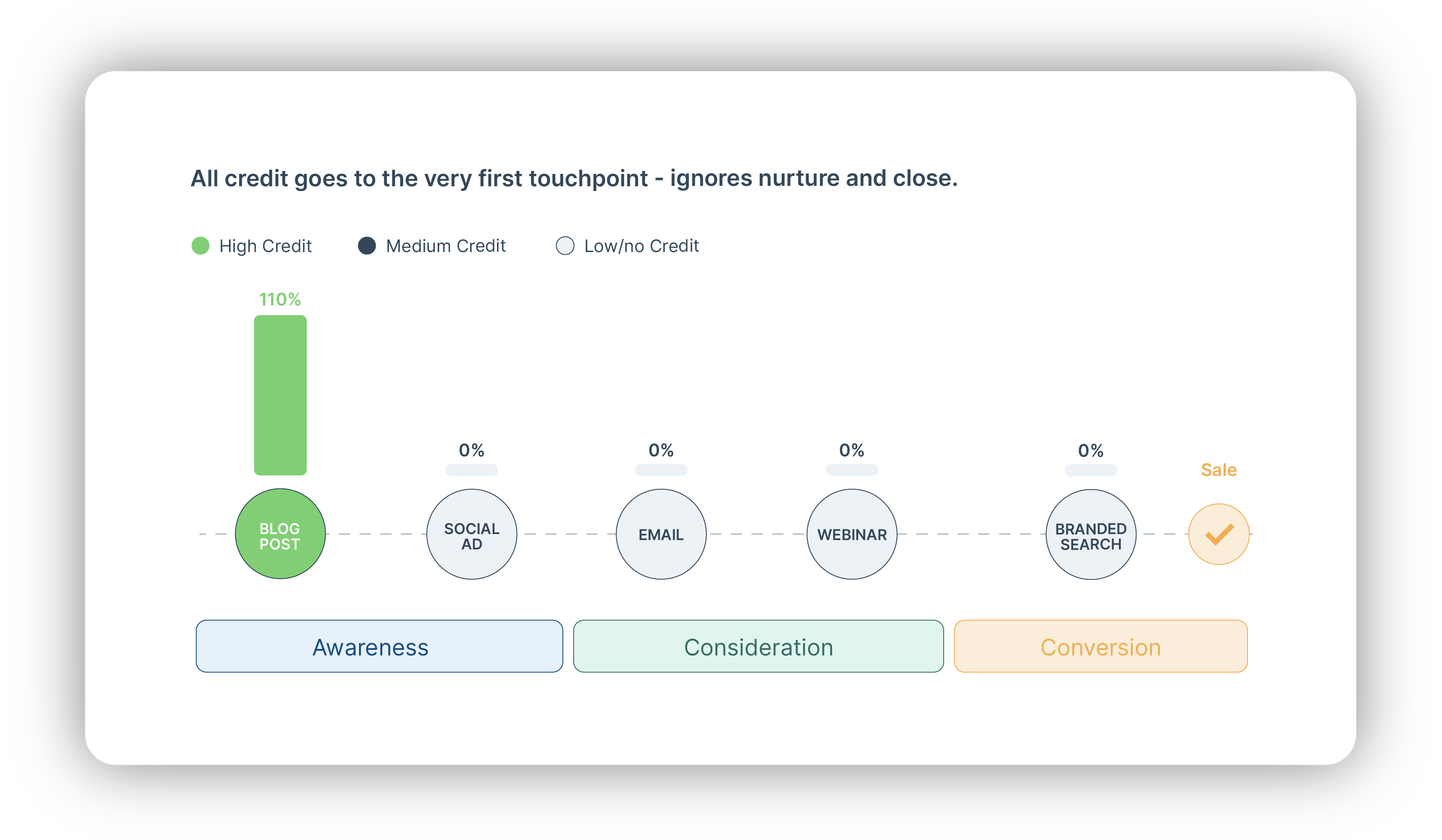
What it is: 100% of conversion credit goes to the first tracked touchpoint in the journey (e.g., first ad click, first organic visit).
Where you see it: Often used by brand teams or top-of-funnel marketers to prove impact.
Operational problem it solves
You want to know what opened the door. First-click attribution helps answer:
- Which channels introduce us to high-value customers?
- Where do most of our journeys actually begin?
Big-picture impact (hidden bias)
- Over-credits early-funnel channels (awareness campaigns, generic search) even if they don’t lead to efficient conversions.
- Under-credits mid and late-funnel nurturing efforts.
- Can justify very expensive channels because they “start” many journeys, even if those journeys don’t close.
Why it’s overused
- Brand marketing wants to show value in a performance conversation.
- Teams confuse volume of first touches with quality of eventual customers.
Best practice fix
Use first-click:
- To understand which channels fill the top of the funnel.
- Together with CLV by first-touch to see which introductions lead to valuable customers.
Don’t:
- Make budget decisions purely on first-click volumes.
- Ignore conversion and CLV metrics downstream.
Combine with: last-click or data-driven views to understand full-funnel performance.
3. Linear attribution
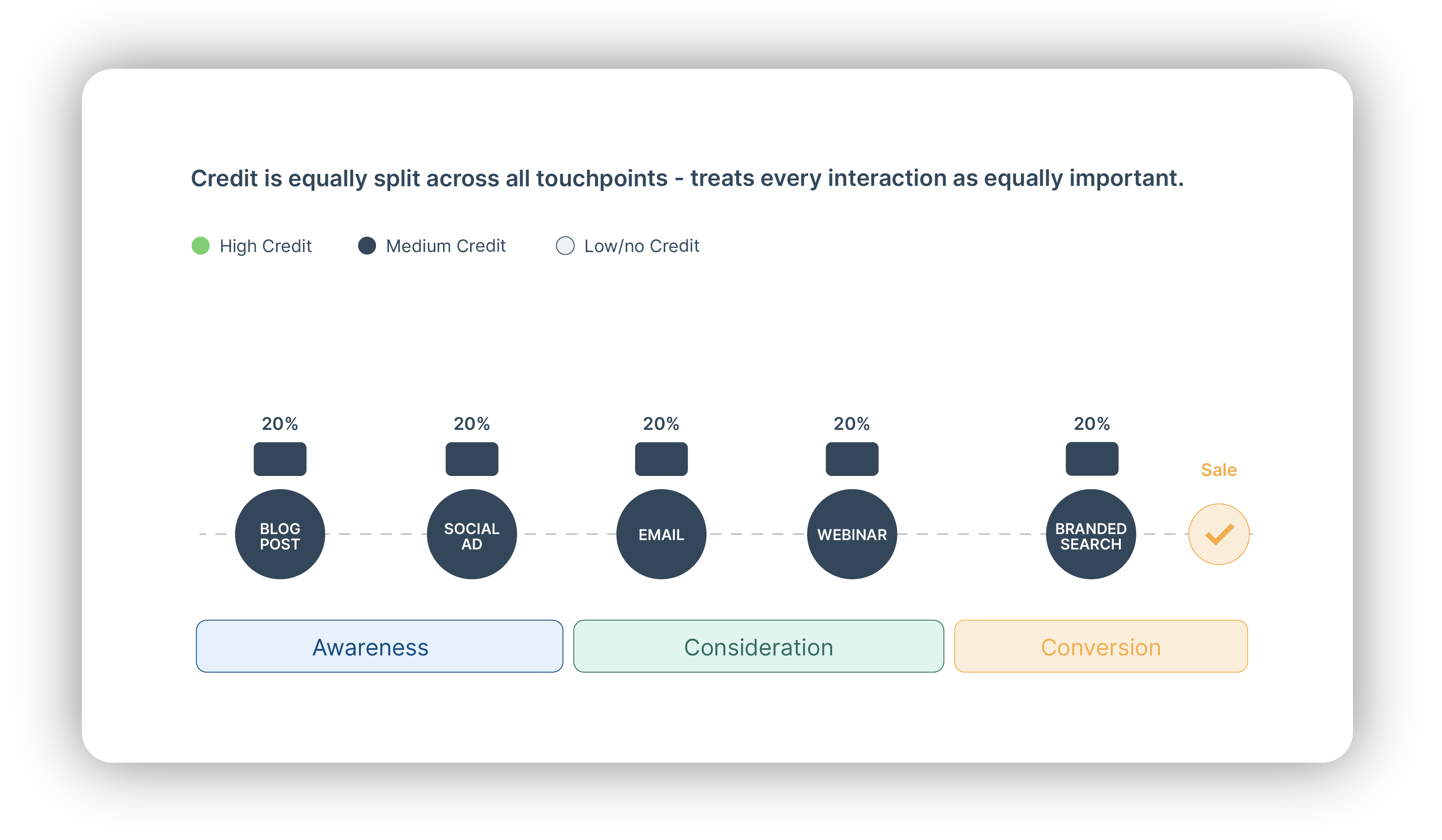
What it is: All tracked touchpoints in a conversion path share credit equally. Example: 4 touches → each gets 25% of the credit.
Operational problem it solves
You want to avoid single-touch bias and acknowledge the full journey.
Advantages:
- Simple better-than-nothing multi-touch model.
- Works when you don’t know which touchpoints matter most.
Big-picture impact (hidden bias)
- Assumes all touchpoints are equally important, which is rarely true.
- Over-values trivial or low-intent touches (e.g., accidental clicks, low-engagement impressions).
- Can make noisy channels look more effective than they really are.
Why it’s overused
- It feels “fair” and politically safe.
- Many tools offer it as an easy multi-touch option.
Best practice fix
Use linear:
- As a baseline multi-touch model when you’re starting out.
- To show stakeholders the complexity of journeys and move away from last-click.
But:
- Layer in quality thresholds (e.g., exclude super-short sessions, bounce traffic).
- Compare against other models (e.g., time-decay or position-based) to see how sensitive your results are.
4. Time-decay attribution
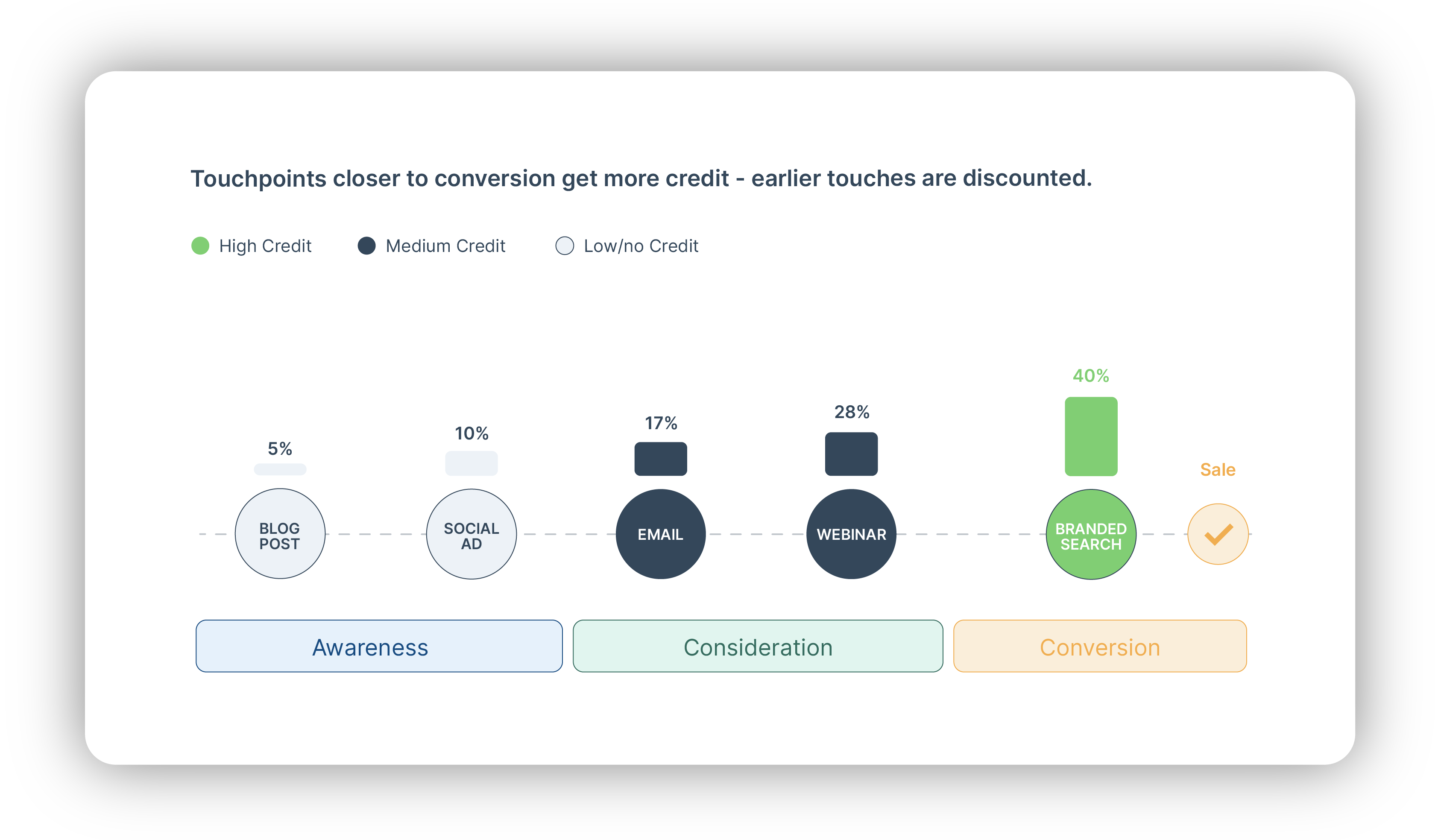
What it is: Touchpoints closer in time to the conversion get more credit than earlier touchpoints. Credit decays as you go back in time.
Operational problem it solves
You want a multi-touch view but with more weight on recent actions that nudged the final decision.
This is useful when:
- Journeys are long, and you want to emphasize recency of influence.
- Late-stage touches (demos, trials, retargeting) are known to be critical.
Big-picture impact (hidden bias)
- Still under-values early-funnel brand and content plays.
- May favor shorter paths disproportionally over longer-but-more-valuable ones.
- Can obscure the impact of channels that act early but decisively (e.g., a strong comparison article).
Why it’s overused
- It feels more “sophisticated” than linear.
- Teams like recency as a concept; it aligns with intuition.
Best practice fix
Use time-decay:
- For businesses where nurture and mid-funnel touches are frequent and important.
- When you want to reward efforts that keep prospects warm as they evaluate.
Check:
- How significantly it changes your view vs linear or position-based.
- Whether early-stage content and brand channels still get credit where deserved.
5. Position-based (u-shaped / w-shaped) attribution
What it is:
- U-shaped: First and last touches get more credit; middle touches share the remainder.
- W-shaped: First, key middle milestone (e.g., lead capture / MQL), and last touch get priority weighting.
A common U-shape split:
- 40% first touch
- 40% last touch
- 20% distributed across middle touches
Operational problem it solves
You need to:
- Recognize the importance of discovery (first touch)
- Reward conversion (last touch)
- Still acknowledge nurture (middle)
This model reflects a funnel logic many B2B and considered-purchase B2C teams are comfortable with.
%20attribution.png?width=3373&height=1966&name=Position-based%20(u-shaped%20%20w-shaped)%20attribution.png)
Big-picture impact (hidden bias)
- Relies on assumed weightings (40-20-40, etc.) that may not match reality.
- Can still undervalue ongoing engagement touches (e.g., multiple product education visits).
- Middle touches become a “blur” instead of clear insight on which nurtures matter.
Why it’s popular
- Aligns with how marketers visualize funnels.
- Easier to explain than fully algorithmic models.
- Feels balanced: discovery + close + nurture.
Best practice fix
Use position-based:
- For B2B or high-consideration B2C journeys with clear “lead → opportunity → customer” stages.
- When you want a conceptually simple representation of the full funnel.
Refine it by:
- Explicitly defining the key middle milestone (e.g., form fill, trial start, demo request).
- Testing different weights (e.g., 30-40-30 vs 40-20-40) to see how sensitive conclusions are.
Document your weighting assumptions so stakeholders don’t treat them as magic.
6. Data-driven (algorithmic) attribution
What it is: A model (often from analytics platforms) that uses statistical methods or machine learning to assign credit based on observed impact of each touchpoint across many journeys. Rather than fixed rules, it estimates:
- “When this touch is present, conversion probability changes by X.”
Operational problem it solves
You want attribution that:
- Reflects real observed behavior, not arbitrary rules.
- Adapts as journeys and channels evolve.
%20attribution.png?width=3374&height=1967&name=Data-driven%20(algorithmic)%20attribution.png)
Big-picture impact (hidden risks)
- Opaque: Stakeholders may not understand how the model works.
- Over-trust: Teams can treat it as “truth” rather than a helpful model.
- Data quality dependent: Garbage in → garbage out.
Why it’s increasingly common
- Tools like Google Analytics 4, some CDPs, and advanced BI stacks push data-driven models.
- “AI-powered attribution” is an appealing narrative to leadership.
Best practice fix
Use data-driven:
- As a primary model for optimization when you have enough volume and clean tracking.
- Alongside rule-based models to sanity-check results.
Guardrails:
- Validate results manually: do the outcomes make intuitive sense?
- Check model stability over time and across segments.
- Educate stakeholders: this is a probabilistic model, not absolute truth.
7. Single-touch custom rules (e.g., “lead source” dominance)
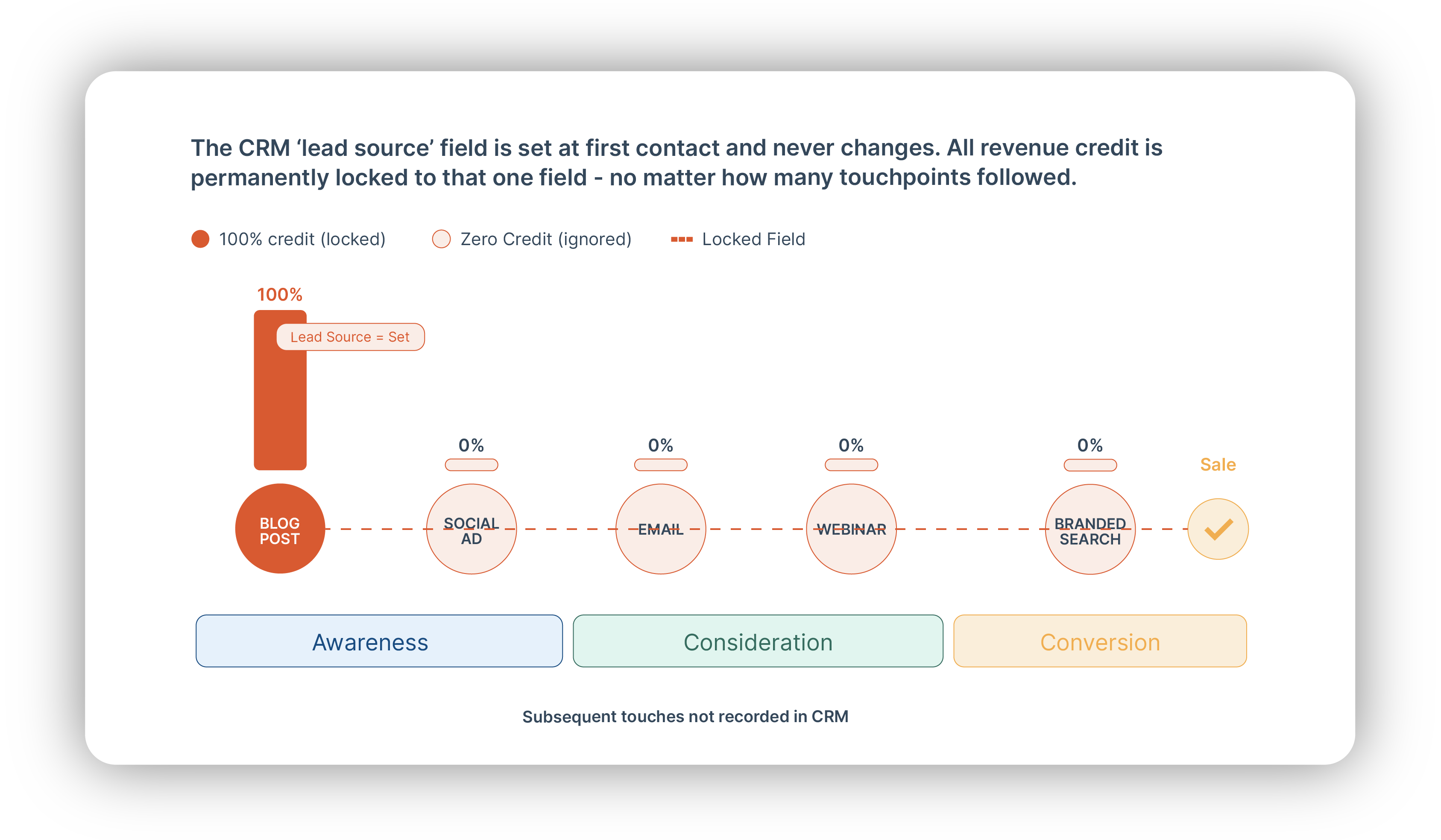
What it is: You pick a single source of truth field (often “lead source” in CRM) and treat it as the attribution channel for all downstream revenue. Example: first known touch becomes permanent owner of all credit.
Operational problem it solves
Sales and marketing need a simple field for:
- Pipeline and revenue reporting
- Salesforce dashboards
- Compensation and incentives
So you pick one field and standardize on it.
Big-picture impact (hidden bias)
- Permanently locks in early-touch bias or whichever rule you chose.
- Ignores ongoing influence of other channels on progression and close.
- Creates major disconnect between CRM reporting and marketing analytics.
Why it’s everywhere
- CRM systems and sales processes are built around “lead source.”
- It’s convenient for compensation and territory logic.
Best practice fix
You probably can’t drop this entirely—but you can upgrade how you use it.
- Keep the lead source for sales ops and comp, but don’t treat it as your only attribution source.
- Enrich with multi-touch data in your analytics platform (e.g., Hurree) for strategic decisions.
- Create separate fields for first-touch, last-touch, and primary opportunity source, if possible.
Think of single-touch CRM fields as one lens, not the lens.
The errors that skew attribution results (regardless of model)
Beyond model choice, there are cross-cutting mistakes that undermine attribution efforts.
Here are five big ones and how to avoid them.
Error 1: Broken or incomplete tracking
Operational problem → Pixels misfire, tags aren’t deployed on all key pages, UTMs are inconsistent, cookie consent banners block tracking, server-side events are missing.
Big-picture impact → Entire channels under-report or disappear. Your model then reallocates credit to whatever is left, distorting your view.
Why it’s overlooked → Teams assume the tracking “just works” after initial setup. Tag changes and site updates quietly break things.
Fix it →
- Run regular tracking audits (monthly / quarterly).
- Standardize UTM taxonomy and enforce it via naming conventions or tooling.
- Implement server-side tracking where possible to reduce browser limitations.
- Centralize tracking status in a dashboard so gaps are visible, not hidden.
Error 2: Comparing apples to oranges across tools
Operational problem → Google Ads, Meta, GA4, and your CRM each show different conversion numbers. Teams cherry-pick the numbers that support their agenda.
Big-picture impact → Attribution discussions become political instead of analytical. Decisions slow down. Trust in data erodes.
Why it’s overlooked → Each tool has different attribution windows, event definitions, and conversion rules. But few people have time to align them.
Fix it →
- Define a system of record for core metrics (e.g., GA4 or a central analytics tool).
- Document attribution windows and models for each platform.
- Build reconciliation views that show why numbers differ (e.g., window, device, conversion definition).
- Use platform-reported attribution for in-platform optimization, but rely on your unified layer for strategic planning.
Error 3: Over-focusing on direct response, ignoring incrementality
Operational problem → You evaluate channels only on seen or clicked conversions, ignoring what would have happened without the campaign.
Big-picture impact → You over-credit channels that harvest demand (brand search, retargeting) and under-credit channels that create demand (upper-funnel media, content).
Why it’s overlooked → Incrementality tests (holdouts, geo experiments) feel complex and slow compared to daily ROAS dashboards.
Fix it →
- Run incrementality tests on key channels or campaigns periodically (e.g., geo-split or audience holdouts).
- Use these tests to calibrate expectations for your attribution model (e.g., “Retargeting shows 10 ROAS, but incremental ROAS is closer to 3–4”).
- Incorporate incrementality insights into your budgeting decisions, not just platform-attributed conversions.
Error 4: Using one model for every question
Operational problem → The organization picks a single attribution model and uses it for everything: budgeting, optimization, board reporting, and channel performance.
Big-picture impact → The model is stretched beyond what it can accurately represent. Different stakeholders need different views—but get one over-simplified lens.
Why it’s overlooked → Multiple models feel confusing to explain. Leadership asks, “Which one is the truth?”
Fix it →
- Define model per decision type:
- Optimization: data-driven or time-decay
- Budget allocation: position-based + incrementality insights
- TOFU evaluation: first-touch + CLV by entry channel
- Sales ops: CRM primary source for comp
- Educate stakeholders: models are tools, not truths. Each is better suited for some questions than others.
Error 5: Ignoring customer lifetime value in attribution
Operational problem → Attribution models credit channels based only on immediate conversions or revenue, not on long-term customer value.
Big-picture impact → Channels that bring in cheap but low-CLV customers look great. Channels that deliver fewer but higher-CLV customers look weak. Budget flows to the wrong places.
Why it’s overlooked → CLV requires stitching marketing and revenue data over time, which many teams haven’t done yet.
Fix it →
- Combine attribution with CLV by first-touch and last-touch.
- Create CLV-weighted attribution views (i.e., channels with fewer conversions but higher average CLV rise in importance).
- Adjust your CAC targets per channel based on CLV and payback, not just first-transaction value.
Hypothetical case study: When last-click attribution kills your best channel
Company: B2B SaaS (self-serve + sales assist)
ACV: $12,000
Marketing Mix: Search, Meta, LinkedIn, content, email, partner webinars
The situation
For a year, the company relied on last-click attribution from GA and CRM:
- Branded search + direct looked like 60% of all conversions.
- Meta and LinkedIn appeared to have high CPAs and low direct conversion volume.
- Leadership pushed to cut paid social and push more budget into search.
Marketing cuts Meta and LinkedIn spend by 50% and doubles down on search.
The hidden reality
Six months later:
- Branded search volume plateaus.
- Organic demo requests decline.
- Sales cycles lengthen slightly.
- Win rates drop in competitive deals.
Finance asks, “We’re spending more on search—why isn’t pipeline growing as expected?”
The team finally runs a multi-touch analysis using a position-based model combined with CRM data:
- For closed-won deals:
- 70% had at least one Meta or LinkedIn touch early in the journey.
- Many started with a thought leadership ad or webinar promotion on social.
- Branded search and direct were often last touches, not the full story.
They also analyze CLV by first-touch channel:
- Deals influenced by early Meta/LinkedIn thought-leadership content had:
- Higher product usage
- Lower churn
- 20–25% higher CLV vs “pure search” leads
The correction
The team:
- Moves to a position-based attribution model in their analytics layer.
- Restores and refines paid social spend, focusing on education and category-proof content, not just demo CTAs.
- Builds dashboards in Hurree showing:
- First-touch channel
- Multi-touch attribution
- CLV by entry source
Within 9-12 months:
- Pipeline and win rates improve.
- Leadership sees that paid social created demand that search then captured.
- Budget and strategy discussions become grounded in a shared, multi-model view.
Moral: The channel you’re about to cut might be the one quietly holding your funnel together. Single-model, last-click attribution nearly cost this team their best upstream source of high-CLV customers.
Strategic & practical takeaways: How to use attribution models without being used by them
Turn this into a playbook you can act on:
- Map your current model landscape.
- What model does each tool use (GA, ad platforms, CRM)?
- What’s your current “official” source of truth?
- Where are the biggest discrepancies?
- Pick a primary model per decision type.
- Optimization: data-driven or time-decay.
- Budget allocation: position-based + incrementality insights.
- Brand impact: first-touch + CLV by first-touch.
- Sales ops reporting: CRM lead source (with caveats).
- Run at least one multi-touch model, always.
- Stop relying solely on last-click or lead source for strategic decisions.
- Start with linear or position-based if you’re early in the journey.
- Audit your tracking and data foundation.
- Conduct regular tag/pixel audits.
- Standardize UTMs and event definitions.
- Connect ad, web, and CRM data into a unified analytics layer.
- Layer CLV onto your attribution.
- Measure CLV by first-touch and last-touch channel.
- Re-evaluate “expensive” channels through a CLV and payback lens.
- Educate stakeholders on model limitations.
- Present comparisons: “Here’s how our view changes under last-click vs position-based vs data-driven.”
- Emphasize: models are decision aids, not incontrovertible truths.
- Test incrementality where it matters most.
- Use holdouts or geo tests for big-budget campaigns.
- Use test results to calibrate expectations and trust in your models.
Attribution becomes a powerful asset when your team understands what each model is telling you—and what it’s hiding.
How Hurree helps you de-bias your attribution and make better budget calls
All of this depends on one thing: a unified view of your marketing, product, and revenue data.
Right now, your attribution reality probably looks like this:
- Google Ads says one thing, Meta says another.
- GA4 has a new model that doesn’t match your CRM.
- Spreadsheets try to blend online, offline, and lifecycle data.
- No one fully trusts any single number.
Hurree is built to fix that.
Hurree acts as the analytics intelligence layer that sits on top of your stack—connecting channels, journeys, and revenue into a single picture you can actually use.
What Hurree Enables for Attribution-Driven Teams
- Unified Data Across Channels & CRM: Integrate ad platforms, analytics (like GA4), CRM, subscription/billing, and product usage tools.
- → You get a single, consistent dataset to run attribution on. No more patchwork spreadsheets.
- Multiple Attribution Models in One Place: Run and compare last-click, first-click, linear, time-decay, and position-based models from within Hurree.
- → See how channel performance shifts when you change the lens on the same underlying data.
- CLV-Integrated Attribution Views: Tie conversions and cohorts to downstream revenue and churn to calculate CLV by channel and model.
- → You make budget decisions based on long-term value, not just first-order conversions.
- Segment-Level Attribution (Not Just Aggregate): Break attribution down by:
- Audience segment
- Industry or company size (B2B)
- Product line or pricing plan
- → You uncover which combinations of channel + segment actually drive profitable growth.
- Automated Dashboards & Alerts: Build dashboards that track attribution outcomes and key shifts over time. Set alerts when:
- A channel’s share of multi-touch credit drops sharply
- Last-click and multi-touch tell conflicting stories
- → You spot attribution anomalies and performance shifts before they snowball.
- Shared Visibility Across Marketing, Sales, and Finance: Give each team tailored views powered by the same underlying data and definitions.
- → You reduce arguments over “whose numbers are right” and focus on decisions.
Hurree helps you see attribution bias before it becomes budget misallocation—and adopt models that actually match your growth strategy.
Don’t let a default model decide your strategy
Every attribution model is a trade-off.
The real danger isn’t picking the “wrong” one. It’s not realizing what your current model is doing to your decisions.
If you let defaults and platform reports dictate your view, you’re quietly outsourcing strategy to black boxes and simplified rules.
You can keep shifting budget based on last-click winners and platform ROAS and hope it lines up with reality. Or you can build a multi-model, CLV-aware view that reflects how your customers actually buy. Don’t wait for your next budget review or pipeline shortfall to discover your attribution has been lying to you.
Take control of your marketing attribution with unified data, transparent models, and dashboards designed for real decisions.
If you’re ready to de-bias your attribution, reconnect it to CLV, and give your team a single, trusted analytics layer, see how Hurree can help:
Try Hurree now and turn your attribution from a reporting headache into a strategic advantage.


Share this

The 40 Most Important KPIs for Marketers

8 Common KPI Mistakes And How to Avoid Them